
Movie Review – A House of Dynamite
Principal Cast : Idris Elba, Rebecca Ferguson, Gabriel Basso, Jared Harris, Tracy Letts, Anthony Ramos, Moses Ingram, Jonah Hauer-King, Greta Lee, Jason Clarke, Malachi Beasley, Brian Tee, Britany O’Grady, Gbenga Akinnagbe, Willa Fitzgerald, Renee Elise Goldsberry, Kaitlyn Dever.
Synopsis: When a single, unattributed missile is launched at the United States, a race begins to determine who is responsible and how to respond.
********
The ultimate nuclear nightmare scenario plays out against a triple-play narrative structure in Kathryn Bigelow’s tense, intelligence- and military lingo-heavy thriller, boasting a sprawling ensemble cast and a backdrop of torn-from-the-headlines global uncertainty. A House of Dynamite’s three-angled screenplay and crosscutting of events becomes more and more strident and fraught as the film plays out, as the United States finds itself under attack from the mysterious launch of a nuclear missile; how the structures of political and military power respond over the relatively brief incursion time is both intriguing and compelling, despite a dour ending that kneecaps the audience with a sombre gut-punch that misses the mark.

Plot synopsis courtesy Wikipedia: The film unfolds in near-real time as an unidentified intercontinental ballistic missile is launched towards the United States, triggering a frantic and politically volatile scramble inside the White House and the Pentagon to determine who is responsible and how to respond. Idris Elba stars as the US President, forced to weigh retaliation against uncertainty, while Rebecca Ferguson plays Captain Olivia Walker, a key military liaison caught between protocol and instinct. Gabriel Basso appears as Deputy National Security Advisor Jake Baerington, working alongside Jared Harris as Secretary of Defense Reid Baker and Tracy Letts as General Anthony Brady, as intelligence fragments, conflicting advice and escalating tension converge in a race against the clock; with global consequences hanging in the balance, the film tracks the intersecting decisions of political leaders, military officials and advisers as they attempt to navigate a crisis with no clear origin and no margin for error.

The structure of A House of Dynamite echoes the subgenre of multi-strand storytelling, in that it essentially replays the same order of a key set of events from alternative viewpoints, occasionally allowing previously depicted moments and dialogue to interject and provide the viewer with a sense of place and time as to what’s going to happen next. Each vantage point — primarily the initial contact and attempts to knock the missile out of the sky by the ocean-based advance warning facility, then the hurly-burly of the White House Situation Room, and eventually the President himself on a public relations lark — is told in excruciatingly exact, minute-by-minute detail, often reprising information but remaining calmly tense throughout, despite this repetition sometimes threatening to derail things. The broad ensemble showcases the complete range of human reactions and emotions to such a catastrophic event — terror, calm, anger, frustration and a rising sense of dread, to name but a few — and the film’s impact is felt largely thanks to the competency of its casting choices and the characters as they’re written.
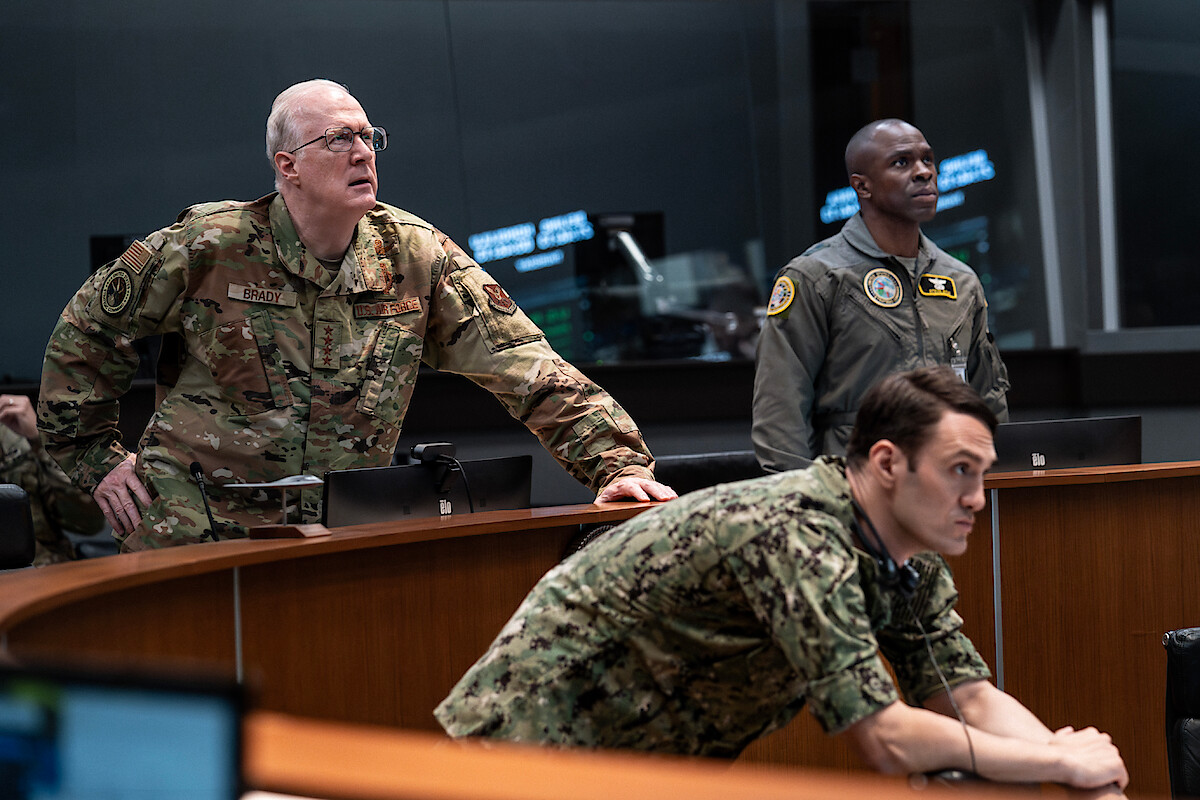
In something of a rarity for Hollywood, the film doesn’t have a quote-unquote leading character performance, allowing the viewer to follow a single emotional journey or character through the arc of terror and despair, instead content to simply dramatise an assumed coordinated response to a missile attack on the United States from these varying perspectives. Key performances from Jared Harris, Rebecca Ferguson and Anthony Ramos, and a confused turn by Idris Elba as a weirdly behaved President of the United States, offer brief glimpses of humanity and frailty behind the command structure, but largely the film is an avalanche of acronyms, louder and louder declarations, military lingo spouted ad nauseam (it all sounds important if you say it just right!) and near-incomprehensible instructional exposition. There’s not really a lot of room for character development when giant LED signs are illuminated at various levels of DEFCON. That said, the cast all do solid work with the material they have, and Bigelow has assembled an eminently capable roster of performers who bring their A-game to the project.

While the strength of the film sits stably on its fingernail-shredding central conceit, Bigelow’s docu-style filmmaking techniques and a proliferation of rack-zoom edits and shaky-cam do become a little tiresome after a while, and I spent a great deal of the film wishing she’d hold the camera steady a little more. If this were a documentary you’d fire the cinematographer for not being able to keep the camera from bouncing around the room and barely keeping important information in the field of view; as an artifice for storytelling and keeping the viewer off-balance it’s a trick that’s used a lot these days, and in this instance I think it’s overused by Bigelow and her The Hurt Locker cinematographer Barry Ackroyd, lacking restraint or nuance. The agitated cinematic style does work when crucial story points are unveiled here and there, but too much of a good thing — or anything, really — spoils the whole meal.

The cinematography isn’t the film’s chief flaw, though. Instead, that honour belongs to the ending — after three solid narrative build-ups to whether the President will launch a retaliatory strike or not, the film cuts to black. The final moments, unresolved as to whether the missile is indeed real, whether it strikes its intended target, or whether everyone survives, feel like a complete cop-out of ninety minutes of tense, angry storytelling. It’s the kind of ending that makes you want to punch a wall, it’s so infuriatingly unsatisfying; after an hour and a half of suggesting a nuclear impact is going to happen, not to show it? To leave so much unsaid, unresolved? Trying to go for the serious, thought-provoking what-if scenario ending, like a terrible episode of Black Mirror? The lack of emotional throughline in A House of Dynamite doesn’t leave room for an absence of catharsis, of release, and by the end of this, as Idris Elba pores over the nuclear handbook on which city might make the best return-serve target, you just don’t give the audience something to unleash the pent-up tension? This, of all the creative choices Bigelow makes, is the weakest aspect of it all, and leaves a rather bad taste in the mouth when the credits roll. Remember at the end of Dawn of the Planet of the Apes, when the virus that brought humanity low is seen in the closing credits spreading across the globe, leaving the audience in no uncertainty about what was going to happen despite the film’s downbeat ending? A House of Dynamite needed an equivalent beat, a way to send the audience out of the film without implicitly stating anything, but also not being an almighty nuclear cock-tease.

Despite this, I have to recommend A House of Dynamite simply for the strength of its premise and the terrific edge-of-your-seat structure deployed by Bigelow and her production team. The great casting also serves to elevate the exposition-heavy plot — you recall that scene in Notting Hill when Julia Roberts’ character is trying to learn lines from some upcoming blockbuster action film and she’s getting all her codes and vernacular mixed up? That’s this entire movie. It’s a nightmare scenario that’s definitely worth a watch; just don’t expect to come out the end of it satisfied.
Who wrote this?