
Movie Review – Condemned (1929)
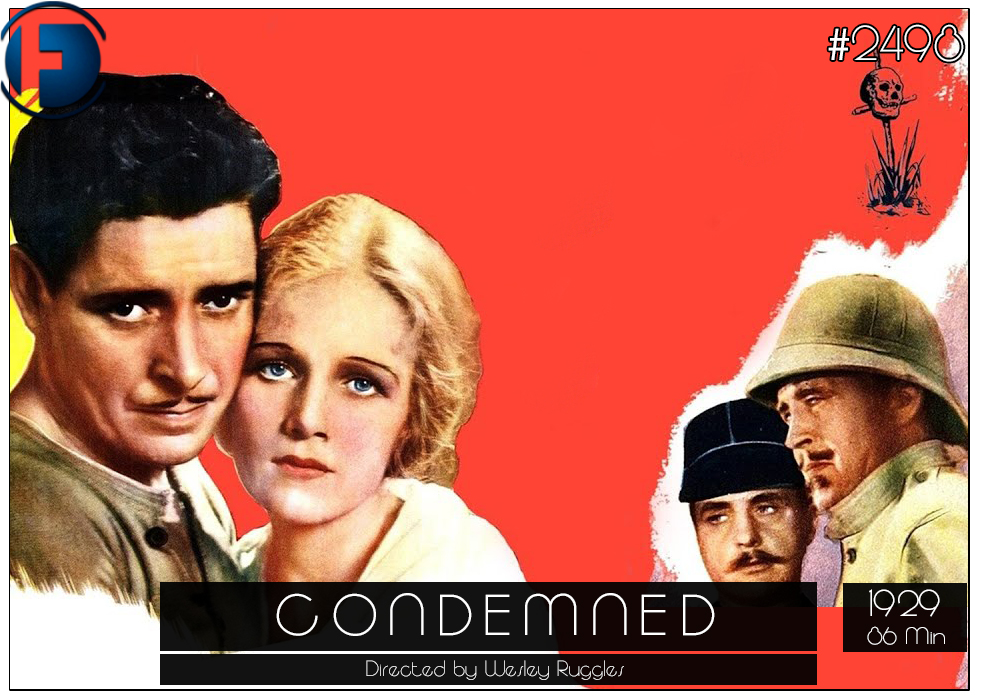
Principal Cast : Ronald Colman, Ann Harding, Dudley Digges, Louis Wolheim, William Elmer, Wilhelm von Brincken, Albert Kingsley, Constantine Romanoff, Harry Ginsberg, Bud Summers.
Synopsis: A thief incarcerated at the notorious Devil’s Island penal colony falls in love with the warden’s young wife.
********
There’s something inherently fascinating about this late-1920s transitional period in cinema, a technological crossroads where the industry hadn’t quite figured out what it wanted to be yet. In my review of Hitchcock’s Blackmail, I touched on the novelty of films straddling the silent and sound eras, and Condemned sits squarely within that awkward, often unintentionally amusing evolutionary phase. Here is a film clearly striving to embrace dialogue-driven storytelling while still clinging, almost desperately, to the exaggerated physicality of silent performance. The result is a curious hybrid: part melodrama, part minor technical showcase, and part historical artefact. It’s not especially memorable as narrative cinema, but as a snapshot of an industry in flux, it holds a peculiar, undeniable appeal.

Plot Synopsis courtesy Wikipedia: Set against the oppressive backdrop of Devil’s Island in French Guiana, the film follows Michel (Ronald Colman), a newly arrived prisoner facing a lengthy sentence in the notoriously brutal penal colony. Michel, however, is no typical inmate; his relaxed demeanour and easy charm quickly ingratiate him with fellow prisoners, including the affable Jacques (Louis Wolheim), and eventually earn him a privileged position as houseboy to the camp’s warden, Vidal (Dudley Digges). Vidal is a deeply possessive man, particularly when it comes to his much younger wife (Ann Harding), whom he treats less as a partner and more as a symbol of status. Isolated and emotionally stranded, Madame Vidal finds herself drawn to Michel’s charisma, sparking a doomed romance that inevitably attracts the warden’s suspicion. Once their affair is uncovered, Michel is thrown into solitary confinement, escapes, and ultimately becomes the target of a desperate manhunt through the island’s humid, treacherous jungle terrain.
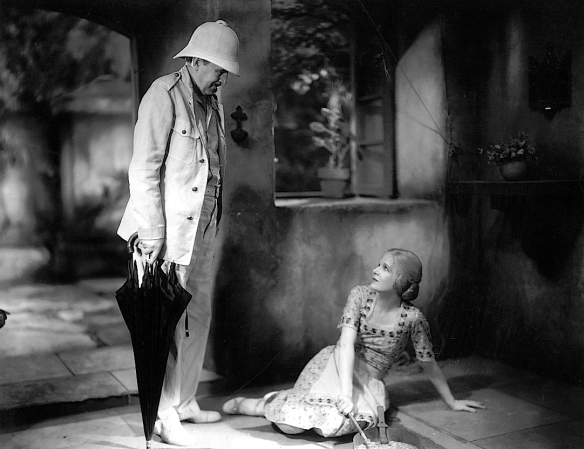
Adapted from Blair Niles’ novel Condemned to Devil’s Island, director Wesley Ruggles delivers a film that is visually ambitious for its time, even if its emotional core never quite lands. There’s an obvious effort here to construct a sense of scale, with expansive backlot prison sets, an impressively realised swamp sequence, and a strikingly effective model-based ocean voyage opening that still holds up as a piece of technical craft. For a 1929 production, this is not a cheap-looking film by any stretch. Ruggles demonstrates a firm grasp of atmosphere, particularly in the film’s early scenes, where the weight of imprisonment and isolation is conveyed through both design and staging. Yet for all its visual confidence, the film struggles to translate that same conviction into its storytelling.
The screenplay by Sidney Howard begins with a tone that suggests something more complex—a blend of melancholy and Shawshank-style character-driven drama—but gradually devolves into a rather overwrought romantic narrative that feels increasingly disconnected from the setting. For a film ostensibly centred on life within a penal colony, Condemned spends surprisingly little time engaging with that reality. Michel’s incarceration feels almost incidental, a narrative inconvenience rather than a defining element of his character. Instead, the film pivots heavily towards the romance between Michel and Madame Vidal, a relationship that escalates with such breathless urgency it borders on parody. What begins as mildly amusing quickly becomes repetitive, particularly as Harding’s character is pushed into increasingly exaggerated emotional states.
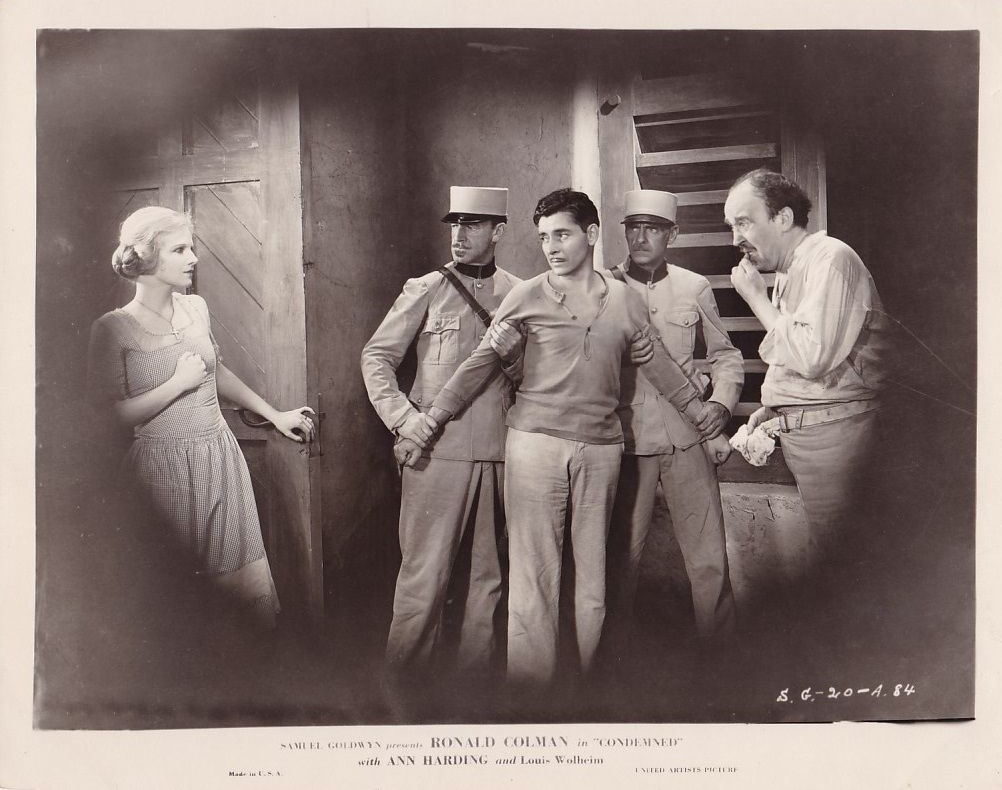
This tonal imbalance is compounded by the film’s transitional nature. Like many early talkies, Condemned can’t quite shake its silent film DNA. Performances often feel pitched to the back row, with actors relying on broad gestures and heightened expressions even as dialogue takes centre stage. It creates an odd dissonance—characters speak, but their physicality belongs to another era. That said, this isn’t necessarily a flaw so much as a defining characteristic of the period. There’s a certain charm in watching a film negotiate its own identity in real time, even if the end result is uneven.
Ronald Colman, however, remains a compelling presence throughout. Effortlessly suave and possessed of that distinctly classical Hollywood charisma, he elevates Michel beyond the limitations of the script. There’s an ease to his performance that feels more modern than many of his contemporaries, and while the film never fully capitalises on his abilities, he anchors the narrative with a sense of credibility. It’s not hard to see why his work here garnered Academy Award attention, even if the material doesn’t quite support a truly great performance.
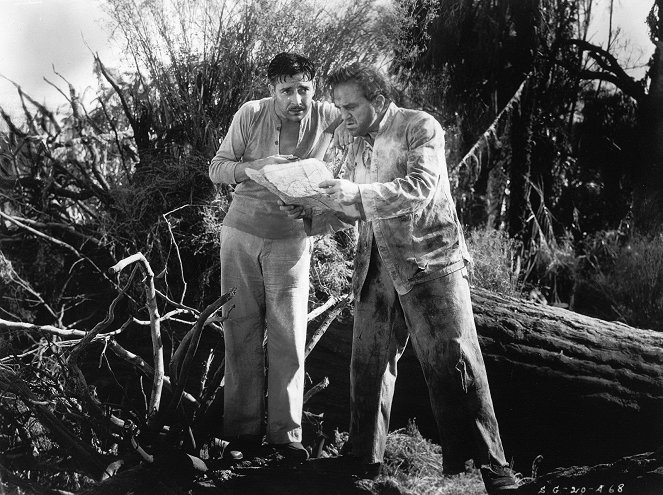
Opposite him, Dudley Digges leans heavily into the warden’s sanctimonious authority, crafting a character that is less menacing tyrant and more blustering bureaucrat. There’s an interesting dynamic at play between Vidal and Michel, hinting at themes of power, jealousy, and class, but the film never digs deeply enough to explore them in any meaningful way. Vidal ultimately functions more as an obstacle than a fully realised antagonist, his motivations simplified into possessive rage.
Ann Harding, meanwhile, has the most difficult task of the central trio, and it shows. Her performance feels caught between styles, at times embracing the subtlety required for sound cinema, and at others reverting to the exaggerated emotionality of silent film acting. The result is a portrayal that can feel inconsistent, particularly as the script demands increasingly heightened reactions from her. There’s no denying her screen presence, but her transition into the talkie format here appears less assured than Colman’s.

Technically, the film offers several highlights that remain impressive even by modern standards of historical appreciation. The swamp chase in the final act is staged with considerable tension, and Ruggles’ use of rear projection is surprisingly effective. These moments hint at a filmmaker eager to push boundaries, even if the narrative framework surrounding them doesn’t always rise to the same level. Elsewhere, the cinematography and editing are competent but rarely inspired, serving the story without ever truly enhancing it.

Ultimately, Condemned exists more comfortably as a piece of cinematic history than as a fully satisfying (melo)dramatic experience. Its significance lies in what it represents—the growing pains of an industry adapting to revolutionary change—rather than in the strength of its storytelling. There are flashes of quality here, particularly in its production design and Colman’s charismatic performance, but they’re undermined by a screenplay that leans too heavily on contrivance and an emotional core that never fully convinces. As a curiosity, it’s certainly worth a look, especially for those interested in the evolution of film language. But as a narrative, it’s a fairly slight, occasionally tedious affair that struggles to justify its own dramatic weight. A brisk, mildly entertaining relic of its time, Condemned lacks any real re-watch factor at all.
Who wrote this?