January 24, 2009

Movie Review – The Lord Of The Rings: The Future – From The Hobbit to The Grey Havens

Filed under: Film - General,Lord Of The Rings,Movie Review — Rodney @ 12:01 am

So what now for the world of Tolkien? After the success of the Lord of The Rings trilogy, and the fact that it paved the way for legitimate fantasy fiction to sweep onto the big screen, New Line began trotting out the concept of going back and filming Tolkiens’ first novel, The Hobbit, which had been touched upon only barely in the Fellowship Of The Rings. The Hobbit seemed like a natural follow-up for the trilogy, even though Jackson had stated that he had “currently” no interest in revisiting Middle Earth so soon after leaving it.

Friction At New Line

Shortly after the Lord Of The Rings Oscar sweep, covered in a previous article, Peter Jackson took unprecedented legal action against New Line Cinema for supposed unpaid royalties on the DVD sales of Fellowship Of The Ring, and publicly stated that the studio had dodgied up the books, meaning Jackson was many millions of dollars short. Whether this was true or not is the subject of another, much more meaningful article, but suffice to say that Bob Shaye, the instigator of the Lord of The Rings trilogy back in 1997, was not happy. He publicly scorned Jackson and went on record that “Jackson will never work for this studio again”, a statement he would later come to regret.

In the years between 2003 (when Return of The King was released) and now, New Line’s fortunes were said to have become more and more bleak, with a string of box-office duds carving a deep gouge into the studio coffers. New Line badly needed a hit, and they knew they’d get one if they could get The Hobbit off the ground. However, there were a couple of problems, before they could do so.

Many moons ago, the rights to The Hobbit were sold to MGM Studios, the makers of the James Bond films. MGM, upon realising that there was money to be made in Tolkien now, wouldn’t sell the rights to MGM, so New Line had to cave-in to the demand to be co-production studio’s for the new film. Many of the cast of the original Rings trilogy films stated that they wouldn’t return unless Peter Jackson was director, putting Bob Shaye into a corner: he had to either retract his previous statement or risk potential fan backlash if they chose another director. Shaye, however, had one key advantage: it really didn’t matter who directed and starred in the film, because it would make money no matter what.

The pressure of the Tolkien fan-base helped force New Line to back down on their statement about Jackson’s future with the Tolkien brand, and this came about around the same time as the legal wrangling of payments was settled out of court. Shaye came out and publicly stated that they wouldn’t make The Hobbit unless Jackson was involved, however, in the intervening years, Jackson had become involved with several other film projects, and could no longer commit to directing the film.

While this disappointed a lot of people, the studio came up with an alternative: Jackson would produce the new films, and he could appoint a director of his choice. Fan reaction to a two-film deal was profound. The first film would be the cinematic version of The Hobbit. The second was apparently a bridging film set between events in The Hobbit and those of Fellowship Of The Ring. Exactly what that would entail was, and to a certain extent, still is, a mystery. In any case, two Tolkien-set films were better than one. The next task was to find a director willing to come into the Middle Earth fold.

Jackson’s choice was a surprising one. Guillermo Del Toro, the director of films such as The Devil’s Backbone, Blade 2, Pan’s Labrynth, and Mimic, was announced as the man who would helm the new films. Del Toro, who is famously adverse to films featuring things like goblins and elves, had spoken at length with Jackson about his involvement, and Jackson persuaded the Spanish-born Director to give it a shot. Fan reaction was immediate. Almost all were overwhelmingly in favour of the choice, and with Jackson providing the guiding light as producer, felt the series was in good stead for being of a similar quality to the original Rings films.

In the intervening months and years since all this took place, fan speculation has been rife with who would play all the roles, whether the same cast could, or would, be used in roles they’d previously done, where applicable. Gandalf was a lock for Ian MacKellan, who had stated he’d love to play the role again. The part of Bilbo, played in the original trilogy by Ian Holm, would no doubt require a younger actor. Mention was made of Gimli returning for a cameo, and perhaps even Legolas as well.

But what to make of the second film, the one not based on any story in particular, but a conglomeration of material gleaned from other sources? Would it focus on events told in The Silmarillion, the posthumous novel from Tolkien that told of the pre-history of Middle Earth? Well, if comments by Del Toro and Jackson are anything to go by, probably not. So what does that leave us with?

The Grey Havens

Looking ahead, it’s hard to see past the initial hoopla surrounding the new Tolkien movies. What else could possibly be done?

Rings composer Howard Shore has already performed the music from the films in a series of concerts, and released almost the entirety of his composed music on CD for fans to access. The extended editions, which were exhaustively backed up by hours of bonus material, will likely be released on new HD disc formats until the end of the world, over and over to capitalise on the success.

Would a filmmaker ever be brave enough to contemplate The Silmarillion as a film project? The complexity and non-linear storytelling style of what is essentially a biblical “let there be light” origin story would be hard to translate to the big screen in a way that was palatable to an audience. I say that now, but no doubt in years to come, somebody will come up with a way. Still, here and now, it does seem unlikely.

The publication in 2007 of a new Tolkien book, The Children Of Hurin, however, has given cause to stop and consider whether we should try translating the rest of Tolkiens works into film. The flash of bottled lightning that was The Rings Trilogy couldn’t possibly be repeated, could it? Indefinitely? Given that Tolkien had died in 1973, it’s hard to imagine any more literature coming from his mighty pen. So where to henceforth for the texts of a man some regard as one of the literary world’s giants.

It’s hard to imagine a world in which Frodo and his kin don’t inhabit some level of public consciousness. At some point, almost everybody in the western world has read, or been exposed to, the works of Tolkien. You’d imagine, then, that the clamouring for film’s and TV works made from his books and publishings might be intense, yet it would appear this is not so. The Hobbit and it’s sequel aside, it’s hard to see anything continuing the legacy of Tolkiens work further into the future.

The Unfinished Tales publication would be utterly unsuitable for filming, as it’s eclectic and “unfinished” nature prevents anything from becoming of these stories without major tampering from a brave filmmaker. Tolkien’s son, Christopher, published a 12 volume series of books examining the entire legacy of the author, including unfinished and alternate versions of his previously published works. And it’s hard to see a studio having a crack at a bunch of unfinished stores for a film.

Therefore, it’s my belief that once The Hobbit (and it’s sequel) make it to the big screen, there will be a dearth of coherent and cohesive story material from which filmmakers can construct a full feature length film, without resorting to the “inspired by” tagline often used when people butcher another’s works. While many have publicly stated that there is so much material to be mined from Tolkiens works, the various back-stories and second-tier characters within the world of Middle Earth, it’s unlikely that fan reaction will predicate such a success as was achieved with the three Rings films. Given this, it would seem at the outset that the current film production of  The Hobbit will be the last chance for people to see a Tolkien film up on the big screen, which is reason to both rejoice and mourn.

No doubt though, with the popularity of the world of Middle Earth, people will find a way to continue the adventures of Tolkiens world, no matter how different it may be. Fan fiction, a popular genre on the Internet, is perhaps the perfect place for people to explore the themes and lands of Middle Earth, using their own words, their own imagination, applying all that Tolkien did to his creation and expanding it, mythologising it, creating a vivid and diverse extrapolation of the work originally begun by the late Oxford don.

A quick perusal of the Internet divulges plenty of fanfic sites, waiting for the hardcore fan to explore, and yet, while not perhaps more commercially accepted, or even blessed by Tolkiens estate, the ability of people to explore his world on their own, is perhaps a subtle way of invoking the myths Tolkien himself lamented being missing in English history: in a way, his beginning has continued on the world wide web, through thousands of people who find it comforting to delve deeper into the world he created.

It’s hard to imagine anybody writing more Middle Earth novels, especially without a surname of Tolkien. To try and make a commercial gambit of the legend of the great man, and further the words he has written, would, at this time, almost be sacrilegious. It would be like somebody writing a new Harry Potter book that wasn’t JK Rowling. Still, perhaps, in the future, authors of renown could try and revitalise the enormous demand for Tolkiens’ world, add to the mythology and the legend….. after all, isn’t that what Tolkien himself wanted? People have written new books about James Bond, well after Ian Flemmings death, so I guess anything’s possible these days.

Whatever the future may hold, in whatever form of media it comes in: the Lord Of The Rings was firstly, and foremost, a book. The use of a persons imagination to create their own versions of Frodo, Sam, the Dark Riders and even Sauron, is perhaps more potent and powerful than anything a director, cinematographer, CG artist or musician could possibly create. And that, my friends will ensure that the novel version of Tolkiens’ opus remains the definitive, unconquered format to enjoy this magnificent tale.

January 23, 2009

Movie Review – The Lord Of The Rings: The Ralph Bakshi Version

Filed under: Lord Of The Rings,Movie Review — Rodney @ 12:01 am

lotr-bakshi-versions

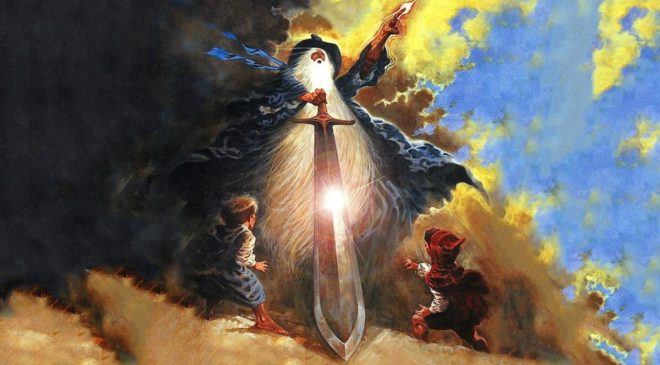
Peter Jackson’s version of The Lord Of The Rings wasn’t the first time somebody had attempted to bring Tolkien’s vision to the big screen. Back in 1978, a filmmaker named Ralph Bakshi had delved into Tolkien’s world to present an animated version of Frodo and Sam, Gandalf and Strider, all with the use of a rather unique form of storytelling: rotoscoping. We thought, in the interests of a more complete review of Tolkiens’ massive tale, we’d quickly touch on the original film version, as released by United Artists, back in the late 70′s.

Bakshi, known for the x-rated film Fritz The Cat, as well as other projects like Coonskin and Heavy Traffic, signed up to direct a retelling of the first part of Tolkien’s epic, based upon events of Fellowship of the Ring and portions of The Two Towers. After the success of a previous film, Wizards, which told of a post-apocalyptic Earth transformed by mutants and humans duking it out, Bakshi had a fair idea of what he wanted to achieve with Tolkien’s massive opus. Initially though to be unfilmable, especially in live-action, Bakshi decided to make the film in a format that could do the mystical and wonderful effect justice: animation. However, not your standard Disney-esque animation, this would be different. Bakshi would shoot all his action in live action, using real actors for each role, and then rotoscope animation on top of them, using merely the movements to accommodate his storytelling. The fluidity of the animation, over the top of live elements, meant a more… well, realistic feel for the film.

Hobbits. Sweet.

Hobbits. Sweet.

Rotoscoping, for the uninitiated, is the art of painting out, or in, an image over the top of a pre-existing film element, to convey an image that wasn’t captured in the original film frame. Mainly known (at the time) for removing wires and cable used to make actors fly or swing through the air, stunt wires etc, the rotoscoping art was a painstaking form of animation that required dedication and expertise from the artisans performing it. More often than not it was tedious, mind-numbing work, and an unlikely form to use as the main source of technique in a film proper.

Still, Bakshi went ahead with his audacious plan, seeing it as the only way to be able to do Tolkien justice. The magical world of Middle Earth, with it’s goblins, Hobbits, wizards, dragons et al, were suitable only for the technical limitations of film at the time, which meant that real-live actors and sets, locations and effects, were not able to deliver the story in a way deemed acceptable.

Assembling a cast that included Christopher Guard, William Hurt and even a pre-Star Wars Anthony Daniels, Bakshi set about filming the sequences in live-action first, then sending the frames to be animated. Not all the voice cast was used for the live action filming, however, as some extras and stand-in’s were used for this work. Key sequences of battles, in which hundreds of people are seen on-screen, were filmed live, then animated, a process which was painstaking in the highest, although the end result was a level of detail much more cost effective to achieve than animating from scratch.

The Fellowhip meets Galadriel in Lothlorien.

The Fellowhip meets Galadriel in Lothlorien.

After years of production, the film, entitled with the laborious moniker of JRR Tolkien’s The Lord Of The Rings, was released, to financial success around the world. Even though it was panned by many critics, who didn’t like the freely edited story and the rather unique (but somewhat disconcerting) style of animation.

Indeed, Bakshi’s Lord Of The Rings, which uses elements of Fellowship and Two Towers, is an inaccurate moniker, as the film is only the beginning of the story: it ends after the battle for Helm’s Deep. Due perhaps to time and money constraints, the original text of Tolkien is used in a minimalist way, with most characters given short thrift in the final film, reducing the powerful elements of the story to simple, five-second bits in amongst a series of stylised, and utterly empty, vignettes. Compared to Jackson’s versions, Bakshi’s original film is almost a Readers Digest version, slashed to bit’s by a studio and audience incapable (at the time) of enjoying such a powerful story told in full. It’s almost a crime to consider that this film was some people’s first look at the world of Tolkien. What must they have thought? Perhaps a little bit of “what the?” at the film ending so abruptly, without a definitive ending of the story.

Hobbiton. Or, perhaps, the villiage of the Smurfs. We're not sure....

Hobbiton. Or, perhaps, the villiage of the Smurfs. We're not sure....

In the effort to bring the popular novel to the big screen, and thus sate the desire of millions of fan’s around the world who wanted to see the story writ large on the public consciousness, the studio backing the project, United Artists (not the current version of the label, mind you, but the original!) and producer Saul Zaentz tried to bring a certain style of vision to the project: almost nobody knew what to do with Tolkien’s story, such was it’s complexity and epic scope, and so (apparently) they simply shrugged their shoulders and allowed Bakshi to make his film the way he saw fit. However, the studio baulked at the idea of releasing a film with Part 1 tacked onto the end (which was Bakshi’s original idea, since the second part would be made and released in due course) and consequently, audience backlash was swift and furious. People went into the cinema thinking they’d get the entire story, which wasn’t the case. United Artists thought that adding a Part 1 to the title of the film would reduce it’s take, since people wouldn’t want to knowingly see a film that told only half the story. In light of Jackson’s version, and the trilogy’s success, it’s easy to see that in hindsight, perhaps United was wrong in this respect. Mind you, the film would have to stand on it’s own, regardless of title on screen, and in this instance, Bakshi’s version actually did just that.

A Black Rider stalkes the Hobbits.

A Black Rider stalks the Hobbits.

Still, it was rightfully criticised for it’s lack of adherence to Tolkien’s original story, a mustering of the ideas into a coherent storyline utterly forlorn for those who had no idea what Tolkien and the One Ring was all about. For me, the film remains accessible only for the fact that I’ve read the books. Had I not, then it’s possible that Bakshi’s version would have flown straight over the heads of most. In any case, the convoluted and somewhat contrived storyline is made even worse by the lack of emotional thrust and character development given to even the most central character.

While Bakshi’s version of The Lord Of The Rings might be considered a classic in this day and age, it’s still not that good a film, based on modern eyes. The story is rushed, the characters half-baked, the themes glossed over in a stylised and awkward animation process that, try as it might, cannot possibly accommodate the elegant and powerful nature of the narrative. Perhaps the most ambitious thing about the film is not the animation, but the way in which large chunks of story are removed from Tolkien’s world, and brushed over in the most brief fashion in the final film. Whole sections of the original text of Rings have been discarded, thrust aside with the brevity of a single line of dialogue like: “Frodo and Sam had many adventures before they reached Mount Doom” which, when you boil it down, means “the studio cannot afford to do the whole thing so we’ve simply taken the most popular bits and animated them”.

Gandalf in action....

Gandalf in action....

So is the Ralph Bakshi version of The Lord Of The Rings a good film? Honestly, as somebody who writes film reviews for a hobby, I couldn’t find it within myself to find anything positive to write about here. I can try justifying the creative decisions made on this film and extrapolate a positive spin on things, but it’s such an inherently stupid film I couldn’t do that to you, loyal reader. Frodo and Sam, much loved characters around the world, are reduced to simple ciphers lacking the depth and characterisation to warrant their adventures: in fact, I’d go so far to say that if Bakshi and the studio thought this film was a love-letter to Tolkien and the world he created, then the poor man must surely be spinning in his grave. It’s a desecration of everything the film ought to have been, both narratively and stylistically. The animation is okay, but not a patch on non-rotoscoped traditional stuff.

While it stood for a long time as the only cinematic treatment of Tolkien’s story, now that we have Peter Jackson’s version, Bakshi’s sampling can only stand in the distant background and goggle at what was achieved, like the rest of us.

snapshot20081227165304

The Bakshi Balrog. We think it's a lion.

As a side note, since the film version of Rings was a financial success, ABC and Warner Bros decided to animate the concluding part of the story, in their traditionally animated format version of Return Of The King. Rankin/Bass, who had, back in 1977, produced a video release version of The Hobbit, were again tapped to produce the version of Return, so I guess, in essence the entire Tolkien story has, at one stage, made it to the screen before Jackson’s, but in a piecemeal fashion not in any way applicable to the quality associated with the authors original intentions. I cannot comment on the quality of these other versions, since neither The Hobbit nor the Rankin/Bass Return Of The King are available in Australia on DVD, or locatable on VHS, at the time this article goes to print.

January 22, 2009

Movie Review – The Lord Of The Rings: The Extended Editions vs The Theatrical Versions

Filed under: Film - General,Lord Of The Rings,Movie Review — Rodney @ 12:01 am

In the rush to capitalise on the success and history of the epic nature of the film trilogy, Peter Jackson, thankfully, had enough foresight to realise that this project would become one of the most amazing cinematic journeys ever captured on handycam. He envisioned a DVD to accompany the films that would give the viewer amazing backstage access to the creation of the three films, from opening scripting and history of the story, to the final film’s Wellington premiere in 2003, and it’s subsequent Oscar sweep, and eventually to the creation of the Extended Edition of the film, seeing his work bow out into history as one of the most celebrated film trilogies of all time.

snapshot20090116183053

The Mounth of Sauron arrives.

New Line gave Jackson unprecedented carte-blanche to go back and insert unused footage back into his original cuts of all three films. While Jackson claims that the original theatrical versions of the films are the intended versions, it’s fair to say that fan attention on his Extended Editions have been overwhelming to the point where they are now considered the canonical versions over what was originally shown in cinemas. We’re going to take a brief look, if we may, at the differences and editorial changes made for the Extended Editions, and how they change the structure and narrative flow of the Theatrical Versions.

snapshot20090116184538

Bilbo loses something.

A Longer Fellowship

Late in 2002, when the Theatrical DVD of Fellowship of the Rings was released, it contained a hint, a glimpse, of what would be known as the Extended Edition of the film, with multiple unused sequences inserted back into the film proper. Promoted as a re-imagining of the original film, the inserted material would not simply be a random collection of deleted scenes, but an utter re-editing of the material to correspond with the footage already used. New music had been written to accommodate the change in edit, as the new footage either lengthened, or changed completely, the original versions. many critics and fans considered the original theatrical version to be almost impossible to improve on, and saw the tampering with the film as “fixing” the Mona Lisa. In other words, what could possibly be done to improve the film? And would adding length and extra scenes to it create something better, or worse.

It’s a fairly safe bet to say that the majority of fans of the films would consider the Extended Editions of each film an improvement on the original versions. By adding in some extra footage that expands, elongates and essentially, fleshes out, the characters and motivations of established lore, you get a fuller, more profound, sense of what Tolkien and Jackson were trying to achieve.

Bear in mind, however, that Jackson’s take on Middle Earth should not be classed as definitive. In fact, the director himself stated in an interview that he feels the story is just his own perspective on things, and that, were somebody else to make a version of Lord Of The Rings, no doubt it would be different tonally than his own.

So, for those following along, the Extended Version of Fellowship manages to freshen up and fill out some slight gaps in the theatrical version that, whilst not adding completely new sequences, add some depth to what we’ve already come to know. A major extension in Fellowship occurs at the very beginning, with a longer version of the opening monologue/preamble, including more footage from Elendil’s assassination, and this flows directly into a scene involving Bilbo writing his stories down in the Red Book, which is a reference to other Tolkien works.

snapshot20090116184620

Frodo and Sam watch the departure of the Wood Elves.

There’s a fair amount of extra material to be found in the Fellowship Extended Edition, mainly increasing the Frodo character and events that surround him: extra Lothlorien footage, battle footage and dialogue sequences, all of which serve to elaborate on Tolkien’s world, add extra emotional drama to an already chock-full narrative. Frodo and Sam’s surveying of the Wood Elves leaving Middle Earth, for example, in which Sam states that it makes him “sad”, does nothing to add to the main narrative of destroying the One Ring; yet it broadens the scope of Middle Earth, allowing something to develop from our lead characters to give them a more cohesive, layered emotional journey. The more we know of people, the more we tend to like them, as a general rule, so if Jackson gives us more detail about our characters’ mindset and moral structure, the more we can empathise, sympathise and care for them when things begin to go bad later on.

With Fellowship setting up the events told in Two Towers and Return, there’s less critical material threaded throughout the extended film, and more of a focus on character development, something I have always been a great proponent of.

So how does Fellowship Extended go up against the Theatrical version? Although certainly longer, is the added languidity and room to move open the film up for increased criticism? Yes, and no. Ambiguity aside, the Extended Version has been considered by the majority of critics and fans to be an improvement, albeit a subtle one, on the theatrical version. Structurally, the film doesn’t change too much, as the characters still encounter the same obstacles and emotional hurdles in the longer film as they travel along. There’s still the same emotional beats within the film, the same emotive highs and lows (Gandalf’s apparent death, for example, at the hands of the Balrog, is subtly expanded using more dialogue material prior to the event, in particular, the foreshadowing of danger as Gandalf warns Frodo to be wary of danger from within the Fellowship…. and glances up as Boromir wanders past) that permeate the edit, the characters not changing substantially from previously established norms.

snapshot20090116183856

Boromir celebrates a victory.

Taller Towers

The second film of the trilogy, The Two Towers, in a way became a better film as the Extended Edition, moreso than it could as a theatrical edit. The problem, as mentioned in the main article on the film, with Two Towers is that it has no definitive beginning or conclusion, it’s a story already begun and not quite finished, so Jackson’s difficult entry and exit from the film is only heightened by the added material in the Extended version of the film. Again, as with the theatrical edition, the Extended version of Towers is replete with problematic issues with it’s beginning, and as before, we slide into the depths of Moria through the wall of a mountain, and diverge onto a different path than we encountered in Fellowship. In Towers, we get a whole lot more Treebeard footage, an extended Helm’s Deep battle (if that’s even possible!) and much more political drama with Theoden, Saruman and Aragorn. In a similar vein to Fellowship’s Extended version, Towers relies more on the added material to fill in some breadth and width to the narrative as a whole, and although the added stuff isn’t essential for your enjoyment of the film, by comparison, Towers is a much better film in it’s lengthier version.

There has always been a lot of fan(atic) hatred towards Jackson’s vision of The Two Towers, primarily for it’s non-adherence to Tolkien’s original narrative to the degree it would appear to be outright revisionism. Characters and events take place that Tolkien never wrote about, such is Jackson’s re-writing of much of the middle book of Tolkiens’ work. However, I feel that as long as the “spirit” of the books is inherent in what’s on screen, then the truthfulness of the narrative compared to original (biblical?) text is not always required to be directly parallel.

For me, the extended version of Towers is the superior version: it’s examination of Theoden as King, and extrapolation of Eowyn as a dominant female character (of which there are far too few from Tolkien) are superb here, both become real characters with emotional journeys, both are significantly improved upon to the degree that their story in Return of The King is all that much more poignant.

snapshot20090116184006

Denethor and Boromir in a scene returned to The Two Towers.

However, for most, Towers’ shining light in it’s Extended format is the inclusion of a key scene featuring Boromir, Faramir, and Denethor, the father of the two. There’s a sequence, which shows a reuniting of the brothers with their father, and the family dynamic that would go on to be a major development in Return of The King. The fact that this sequence was left out of the Theatrical version is disappointing to me, as I felt it created a wonderful touchstone moment, and dynamic dramatic twist, for those unfamiliar with Tolkien. Fan’s would be aware of the pressure Boromir was under to bear the family name, as well as trying to get out from under his father’s dominating thrall: and Faramir, who is the despised younger son, to try and win his fathers love by doing good deeds and showing his “true qualities”. Denethor’s reaction in this simple, single scene, explains a lot about Boromir in Fellowship and set’s up the events in Return. John Noble, playing Denethor as a dominating and slightly garrulous old man, clutching at pride and honour until the last, you suspect, is cringe worthy here (in a good way, that is) and you instantly begin to hate the character. Jackson’s overt portrayal of Denethor as a mad, hopelessly disappointed father in his film perhaps goes against that originally written in Tolkien’s texts, however it adds a rather substantial emotional weight to what would come later.

In short, this single scene makes The Two Towers’ Extended format a far superior film to it’s theatrical cousin.

snapshot20090116183023

The Black Gates Of Modor.

The Return of The Epic

At a little over four hours, you can be forgiven for thinking Return of The King’s Extended version is an exercise in bladder control and audience torture. To be blunt, the film is tremendously exciting, if a little wobbly in the narrative in it’s latter stages (with some bemusing and confusing lapses in logic in the story, time and space, as the battle of Pelennor takes place) experience. Return of the King is a massive narrative event, various strands of story vying for room to move within a film that’s bordering on the narcissistic in it’s length. Indeed, Jackson was criticised for the films multiple endings, of which there are many, as being overtly tedious and unnecessary (I disagree, to be honest!) and it was felt that had the film been trimmed slightly, it might have been even better! Strange to consider this when it won Best Film at the 2003 Oscars, the first time a fantasy film had ever achieved this feat.

However, most people agreed that the Extended Edition was a superb improvement on what was already being hailed as a genuine screen classic (indeed, it’s Oscar fortunes would have indicated it’s “classic” status long ago) and went on to perfectly conclude the massive story and journey undertaken by the previous two EE versions.

snapshot20090116183538

Saruman is stabbed by Wormtongue.

Return Of The King’s Extended Edition is the least narratively expanded of all three films: instead, the extra footage is a combination of dialogue sequences, action (especially in the Pelennor Field’s battle) and wholesale revision of the original storyline. All our major characters get a lot more screen time and character development (which can only be a good thing, surely?) and the battles and conflicts are expanded and improved significantly. The charge of the mumakil in Return is expanded, with a longer sequence of the carnage caused by these massive beasts. There’s greater import in the Mouth Of Sauron sequence, deleted from the Theatrical version since it brings up a logical loophole in the audience’s journey: it’s re-inclusion is genuinely dramatic, and altogether creepy….. if slightly too short. The Mouth Of Sauron, the spokesperson of Mordor, who appears when Aragorn leads the remnants of his army to the Black Gates, is played by Aussie Bruce Spence, who most will recognise from his many and varied roles in cinema, including Mad Max, and as the Trainman in The Matrix Trilogy. His CGI enhanced features are genuinely scary, and extremely well done. When he torments Aragrorn, Merry, Pipping and Gandalf with the supposed death of Frodo and Sam, it’s a genuinely moving moment. Although, given the fact that we, as the audience, know the pair are actually okay, you can see why Jackson removed it for the theatrical version… it’s redundant to a certain degree, and perhaps not really applicable for the climax of the film at that stage… which it was.

snapshot20090116183115

The digitally enhanced Mouth Of Sauron.

For me, though, there’s plenty to enjoy about the Extended Return Of The King. The originally excised death of Saruman, which was controversially dropped from the theatrical version (much to the dismay of both fans and star Christopher Lee) is restored, allowing us to see the final fate of the evil wizard. Lee was publicly fuming over the removal of what he considered a key scene, the death of the main antagonist from Two Towers, from the second and third film. At the end of The Two Towers, we would have seen his demise once Aragorn, Theoden, Gandalf and Gimli showed up at Isengard after leaving Helm’s Deep…. however, this was to be held over to film three. Once the edit on film three began to take shape, Jackson quickly realised that the scene, in which Lee plunges to his death after being stabbed by Wormtongue (Brad Dourif) on the top of the tower of Isengard, was not the best way to open a film… “killing the second film’s antagonist in film three is just wrong” Jackson is quoted as having said. So, Saruman’s death scene was removed from the theatrical version, much to the disgust of Lee. However, in the Extended Edition, the scene is returned in all it’s glory, and it finally gives us the satisfaction of seeing the Betrayer in his last moments, get what was coming to him…. it’s glorious.

Honestly, Return suffers a little more for it’s added length as a film than the other two, since the action seems to take an eternity to get to, this time around. However, for the weight and depth of the character development that Return now contains, you’d be hard pressed to be overly critical of what was put back in. I think, as far as the trilogy goes, that Return Of The King is the film that towers above all others for it’s extra content.

snapshot20090116184140

Flag of Gondor.

Which is better, Theatrical or Extended?

As any film fan, and they’ll tell you that the Extended Editions of the trilogy are perhaps the single greatest work of art produced by one director, with the possibly exception of The Godfather Trilogy. Lord Of The Rings represents the highest quality of craftsmanship, workmanship and directorial skill to bring to life: the unfilmable novel has finally been filmed in a way that will never be equalled in our lifetimes. While the original Theatrical versions are no doubt classic film in their own right, the Extended Editions allow the viewer to integrate themselves fully into the mental landscape of Tolkiens world, to fully appreciate the scope of this massive film project, and to get a deeper understanding of what the characters, who are the most important thing of the whole show, are thinking, feeling and experiencing.

It’s my humble opinion that if you have never seen the trilogy in it’s extended format, then you simply haven’t seen it.

January 21, 2009

Movie Review – The Lord Of The Rings: The Return Of The King

Filed under: Lord Of The Rings,Movie Review — Rodney @ 12:01 am

By the time Peter Jackson’s film version of The Return Of The King was due to hit cinemas across the world in 2003, most people were either confident in the director’s skill to bring the story of Frodo, Sam and Gollum to a satisfactory conclusion, or terrified he’d stumble at the final hurdle. The two previous entries in the Lord of The Rings film trilogy, Fellowship of The Ring and The Two Towers, had been massive commercial and critical successes. Most people wanted the trilogy to work: however, the Hollywood law of diminishing returns meant that, technically, sequels of successful films generally made less money, and were not as good as, the film they spawned from.

That said, people needn’t have worried. When Return Of The King was unleashed upon the world in December of 2003, all fears proved unfounded. Jackson’s (or ours, depending on how you look at it) luck had held firm. Return Of The King was an unparalleled success.

With the first two films of the trilogy safely tucked away, with both Theatrical and Extended DVD editions available to the public, Jackson’s full focus was now on bringing the gargantuan story to a satisfying climax, and emotional resolution. With Frodo and Sam, along with Gollum, still to traverse the despairing wastelands of Mordor, to the steep slopes of Mount Doom, you got the feeling that the film had a fair amount of material to cover.

snapshot20081227175524

My preciousssssss!

Broadening The Story

Conversely to Tolkien’s original story, Return Of The King the film was the longest of the three in the series. Clocking in at nearly 3 and a half hours, it’s a monster; both in terms of storytelling power and narrative excitement. The novel, in it’s original form, is barely half, if not a third, the length of series originator Fellowship. When reading Return Of The King, it’s clear to see that Tolkien’s initial love of long exposition within the text body had waned a little, perhaps as the story sped up, he felt the need to compress his writing. The published novel of Return is almost able to be divided in half again, the first part being the body text, the second being the Appendices, the vast supply of information and back-story to a lot of what occurs in The Hobbit and The Lord of The Rings. Was Tolkien “rushing” his final book? Was he pressed for time, and forced to condense the final act of his work into a story that was limited and mediocre by comparison to what had come before?

Tolkien was initially reticent to publish his work, The Lord Of The Rings, in three separate volumes. He figured that since it was all one piece of literature, it should therefore be published as one piece of literature. It’s commonly known now that his publisher was able to convince the author that to publish all three parts in one collective volume would be both prohibitively expensive, and almost impossible to market (since the page count was inordinately high) so the story was broken up into the three novels we’ve come to know today, Fellowship Of The Ring, The Two Towers, and the final chapter, The Return Of The King.

snapshot20081227180312

Dark, dangerous and deadly... but MAN what a view!

With Fellowship, Tolkein spent a great deal of time setting up the world, the characters, and the idea of the Ring and Sauron, and what had to be done. His passion for this world is evident in almost every line and paragraph, the detail with which he scribes his ideas is staggeringly exquisite. The journey from the Shire to the sundering of the Fellowship on the shores of the Rauros takes place over many pages, and The Two Towers, while substantially compressed for detail, posits a large quantity of information in a short literary work, relatively speaking. The Battle for Helms Deep, for instance, takes only a chapter of The Two Towers, however the film version last almost half the movie. With Return Of The King, however, everything goes pear-shaped quite quickly. The carefully constructed world and language Tolkien had developed is given short thrift in the novel, instead allowing the War of the Ring to come to a head, be fought, and won or lost in a few pages. The battle at Minas Tirith, on the plains of the Pelennor Fields, is described in the book in rather brusque detail, for Tolkien. Tolkien appears to blanch from the intricacies of detail he used in previous instalments, instead seeming to want to paint sweeping vistas with large scale carnage and action in it’s place. Whereas before you could almost smell the forest and trees of Lothlorien and hear the whistle of arrows in Helm’s Deep, in the literary version of Return you merely get a sense of it all, almost as if the detail is lost as the reader tries to look in multiple directions at once. It must be noted, I feel, that it would appear that Tolkiens’ language in Return Of The King is surprisingly elegiac, a mournful dread hangs across proceedings, as it must, I guess, when times are darkest. Tolkien writes Return almost as a poem, a kind of lamentation to horror unfolding and lives lost, as if he’s painfully aware of the agony Middle Earth is enduring as the forces of evil sweep the land. As such, the fine detail accounts so brilliantly written in Fellowship are somewhat less so conspicuous here, instead the broad brushstrokes of a writer trying to accommodate the bulky, weighty story he so accurately developed until this point into a cohesive, understandable narrative. To me, and this is just my opinion, Tolkien appeared to want readers to be less inclined to follow individual stories and more interested in the world-view aspect, the birds-eye look down as God would upon the landscape, assessing all aspects virtually simultaneously.

snapshot20081227175549

Eowyn moons for Aragorn

Jackson and his writing partners, Philipa Boyens and Fran Walsh, expanded and structurally deviated from the written word of Tolkien, continuing the moulding and manipulation of time and place within the context of their established film format. The Battle of Pelennor Fields, and the War Of The Ring, take up almost two thirds of the film. Intercutting that with Frodo and Sam journeying up the mountainside and though the brimstone-wracked landscape of Mordor, the political machinations of Rohan, and Aragorns internal struggle to accept that he is destined to become King of Gondor, and Return Of The King becomes a film bogged down with so many plot developments and character storylines, it’s amazing the whole thing doesn’t collapse under it’s own weight. What is great about Return, and about the previous films as well, is that they are essentially ensemble pieces, and so the audience now expects to be following multiple stories and characters. The audience is willing to follow the characters we’ve grown to love over the years as they now struggle through their darkest moments. Except for Gimli and Legolas, whom again become the light-hearted humour in the film.

The problem with ensemble films generally is that somebody, somewhere, gets short thrift in terms of character arc: as with Fellowship and Towers, Return manages to shoehorn everybody’s character into the film and still give you a decent development of each one. And aren’t there a plethora of characters!

snapshot20081227175554

A reflective Gollum. Ha. gettit?

Frodo and Sam, and Gollum in his own way, required the most massaging from Jackson and his writers for their character development, as the journey to destroy the Ring is the key part of the film, and the whole purpose for the story in any case. Frodo’s descent into madness, his resurrection from despair and emotional obliteration is one of the film’s strongest points, analogous to the despair we all feel at times during our lives, when things seem darkest, and there’s no way forward. His light, his touchstone of hope, you might say, is Sam, whom carries Frodo when all seems lost. Figuratively, and literally, Sam is the real hero of Return, moreso than the Rohan warriors riding into the swollen armies of Sauron, moreso than Eowyn standing to face the Witch King of Angmar on her own, sword in hand. Moreso even than Aragorn turning, anguish on his face as he thinks Frodo is dead at the last, and despairingly imploring his troops to charge against the gates of Mordor in a last effort to defeat evil. Sam is perhaps the bravest soul in Middle Earth, not for any physical ability, not in the least. For his courage to lift his friend up when he falls, to take the burden that is slowly killing Frodo and assume it himself; not out of jealousy or anger, but because he knows that he’s the only one who can. Frodo, weakened by the power and influence of the Ring, is unable to bear the burden any further, as they lie, soot-stained and exhausted, on the side of Orodruin, being Mount Doom. His gasping, raspy voice quavers as he seeks faith from Sam, pleading with him to justify this madness, this journey, and why they must continue. Frodo is wrecked beyond accounting, his body scarred and battered from his burden, his fight with Gollum and his battle with Shelob. It is when Frodo is at his weakest, both in body and mind, that Sam steps up. Jackson and Walsh, along with Boyens, have delivered a hero unlike any we’ve seen before on screen: a hero who isn’t the main character. Ultimately, Frodo is unable to finish his task. His resolve is so weakened by the time he stands above the fires of Mount Doom, on the precipice looking down into the lava, he cannot abandon the Ring. It is a mirror upon the same resolve of Bilbo, who was threatened with obliteration by Gandalf in order to give up the Ring’s power. Both Bilbo and Frodo, members of the same family, are ultimately both unable to do what must be done, alone. They require help, and in Sam, Frodo has his strength.

snapshot20081227175558

Absolutely gorgeous.

Gollum, meanwhile, continues on his own pathetic, sad journey. It’s not the character itself which is sad, or even pathetic, but when one realises the level of despair and loneliness Smeagol/Gollum has experienced through life, he almost becomes a sympathetic character. He’s not driven by a list for power (at least, not as told on-screen – in the book, Gollum wants the Ring for himself so he can continue killing and scheming in the depths of the mountain) so we attach ourselves as viewer to his plight in that he’s simply a beast of instinct. Gollum’s overriding schizophrenia is simply awful, you can see the twitches and quivers of his resolve and motivations as his Smeagol (good) side internally wars with his Gollum (bad) side throughout the film. It’s Jackson’s handling of Gollum that turns him from being simply a good director, to being a great one. The script allows us to feel Gollums torment, his anguish, the desire unlike any other to claim the object of his position in life: without the Ring, Gollum feels empty, unable to be himself. Perhaps the greatest pity of Gollum is that the Ring is the thing that caused him to become who he is in the first place, and it’s here the sympathy of the audience is generated. In the back of our mind, all the while, is the fact that at one point, Gollum was just like you or I. A normal, sensible person, who is overcome with lust for an object capable of giving him power that he was deprived of in his early life. The power to become invisible, while certainly never expanded upon in the films at all (all we see is the alternate-world view experienced by Frodo in Fellowship) is a juicy, divisive element within Tolkien’s landscape. Tolkein saw that particular power as perhaps a way of dealing with his own problems at the time: after all, if one could simply vanish, would that mean one’s problems did too? In a world wrecked by war, Tolkien must surely have wished himself invisible, perhaps he was unable to come to grips with the death and destruction around him, and he sought escape in his literary works: inside of which he felt somebody had to feel as he did. Gollum’s journey in Return, which began so brilliantly in Towers, is again magnificent. His is a character with depth; in almost any other film, he would have been a one-dimensional character lacking in emotional depth and merely a cipher for the Hero to do his thing.

snapshot20081227175603

Not quite as gorgeous as Liv Tyler, but, I guess, attractive in his own way....

Aragorn, to my mind, is perhaps the least accessible of the characters in Return Of The King. His journey began so well with Arwen back in Fellowship, and he became a leader in Towers when he battled at Helm’s Deep, however, he appears to lose his way in Return. Suddenly, Aragorn is beset with fear as to his heritage, his lineage telling him one thing and yet his heart saying another. He needs more convincing, apparently, and doesn’t relish the idea of ruling over an entire country. One might say this is a decent quality: the best rulers are those who do not seek to rule, who will govern fairly without prejudice or favour, however the more cynical might say that the best rulers are those who want to rule, for the pride and valour in leading people through tough times and good will bring out your best qualities. To me, however, I see Aragorns’ journey through Return as a little wayward, a little out of character. Aragorn never struck me as a character who would sit and think about things for too long, being all indecisive. His character always appeared in control and above conflict, he knew what to do every step of the way, made decision quickly and resolved a situation with little fuss. Perhaps, then, he needed to be indecisive, needed to feel insecure in his decision making to grow as a character. Like Frodo, Aragorn takes a little prodding from a good friend (in this case, Elrond, who returns the remade Sword Of Elendil to him) to sort himself out. But on screen, it’s not convincing. It’s almost like Jackson and Co didn’t quite know how to handle this part of the story, so they made Aragorn a little angsty, a little teen-rebellion all of a sudden. He kicks all manner of ass in Helms Deep, and then starts to doubt himself? Who is he kidding? Still, his storyline in the final act of the film, where he leads an army across the plains to confront the armies of Mordor streaming from the Black Gates, is powerful, genuinely emotional stuff. He loses his way a little in the middle of the film, but gets back on the horse at the end.

snapshot20081227175618

Hiding in corners always worked for me too....

The character development of the other Hobbits, Merry and Pippin, is a substantial bonus for the film. In the novel, they’re underused and only really mentioned as ancillary members of the story at the point Return kicks into gear. In Jackson’s version, he expands their stories into a more rounded, well developed and natural way.

Merry, who returns to Rohan with Aragorn, Legolas and Gimli, befriends Eowyn, the niece of Theoden. When called into battle, Merry wants to take part, however Theoden requests he stay behind, as he see’s Merry more as a liability. Merry, pouting slightly, utters one of the film’s best lines: in which he describes himself as an inhabitant of Middle Earth as well, and wonders what will happen to the Shire should Sauron defeat the armies of Men. It’s a far cry from the Merry of Fellowship, more in tune with stealing carrots and potatoes and cooking up mushrooms. As the tone of the film becomes more and more grave, we see less of Merry’s natural humour, and more of his serious side: a sense of honour and faithfulness to the cause that we had ne’er before seen in the young Hobbit. He refuses to bend to Theoden’s will, and, with a disguised Eowyn carrying him on her horse, he joins the Battle of Pelennor Fields and finds his courage. The idea of self sacrifice, embodies in a variety of ways through every character in the film, is one Tolkien espouses greatly within Lord Of The Rings, due in no small part to the “for the greater good” mentality during the World War’s that plagued the Earth in the early half of the 20th century. One man’s sacrifice might very well save hundreds of others, so no thought was given (at the time) to one’s own life, instead, in the defiance of evil, you became part of the mob, part of the whole, like a wave of humanity sweeping onto the beach of War, erasing the footsteps of tyranny in the sand before you. Here, in Merry, we see a similar sentiment, in that he wants to fight, even against incalculable odds, an almost unwinnable battle in a land that isn’t his own. Sounds awfully familiar, I think.

snapshot20081227175637

The ugly guy from The Goonies gets more work....

Pippin, almost parallel to Merry, develops as a character as well. While he may not become involved with the Battle directly, he does so in an indirect fashion, as he hides in Minas Tirith to draw Sauron in that direction, whilst Frodo and Sam continue their quest from another. Pippin becomes the Poker Face of the War, Sauron’s focus is on him when it should be elsewhere. Pippin, while also a joker at the start of the story (with his resolve hinted at during a frightening moment in Fellowship where the Black Riders almost catch Frodo with the Ring… “Buckleberry Ferry? Right, follow me!” he says, his eyes set.) develops into an emotional, pragmatic and almost egalitarian soul, who learns (painfully) that the world is not all green grass and mushrooms. The script allows Pippin to learn these lessons through both the actions of Gandalf and Denthor, the former being the kind and wise wizard who take Pippin under his wing, and the latter a bitter, mentally destroyed old man bent on conforming the world to his own will, not accepting that things are changing.

Perhaps the other key character in the film who requires a little prose is Eowyn, the younger niece of Theoden, King of Rohan. Eowyn represents the feminist movement in Middle Earth, her character buffeting against the tide of male dominated affairs with her people; women of Rohan are not allowed to fight, something she opposes quite strenuously, although Theoden forbids it. Regardless, when the fight begins, Eowyn joins the battle, and eventually strikes a decisive victory against the armies of Mordor, as she slays the Witch King of Angmar in hand-to-hand combat. Her moment, her shining light in the battle, is a moment in the film which will make you punch the air with a “that’s the way!” cry. Eowyn, played wonderfully by Miranda Otto, is one of the major players of this film, although I feel her part is slightly underdone by Jackson in terms of emotional content. Her scenes with Merry, as she carries him to war and stands by his side as they fight Orcs on the ground, are particularly powerful, however I think Jackson short-changed the character a little in his initial cut. The Extended version, all of which will be explored further in a separate article, expands her role somewhat, although only marginally.

snapshot20081227175657

The calm before the storm.

Jackson and Co managed to expand the characters from the written page of Tolkien’s text into people with depth, a sense of purpose and logic behind them. By delving into the appendices, and taking anecdotal and ancillary material from other texts the author wrote over his lifetime, Jackson was able to find more detail about the characters that weren’t immediately apparent in the body text of Return. The expansion of Denethor, for one, was an element that I felt was overdue, however, the handling of this part of the story was a little off-key. Denethor is a complex character, for sure. His inability to handle the death of favourite son Boromir is the catalyst for the lack of preparation (and Gandalf’s subsequent subversion of his troops) for the approaching War. His mind is broken, and I can see how Jackson has tried to portray that on screen: for me, though, it rings a little hollow. Perhaps its the slightly garrulous acting style of John Noble, who seems for all the world a little lost in his characters oblivious mumblings, but I just felt that Denethor’s role, and the way it was handled by Jackson, wasn’t as well rounded as it perhaps could (or should) have been. But, at least they tried. It’s a testament to Jackson that any of this worked at all, let alone a single failing in the character department make this film fail miserably. One of the advantages of an ensemble film is that if one character is shallow or undeveloped, there are others to pick up the slack. Of course, that being said, it could also be conversely construed that if one of an ensemble fails, then it drags the rest down too. Thankfully, this did not happen in Return.

snapshot20081227175740

The storm.

The final battle at Pelennor Fields, before the walls of Minas Tirith, is expanded substantially by Jackson from the original text. While mention is made of almost every element on screen within the original text, Jackson has taken that mention and created entire sequences out of them. Case in point: the mumakil. The giant elephant creatures, or mumak’s in Tolkien’s language, advance upon the armies of Rohan who have taken the field on horseback, stomping and sweeping aside all who get in their way. In Tolkien’s original text, they are mentioned as follows:

“And now the fighting waxed furious on the fields of the Pelennor; and the din of arms rose upon high, with the crying of men and the neighing of horses. Horns were blown and trumpets braying, and the mumakil were bellowing as they were goaded to war……..”


“…….But wherever the mumakil came there the horses would not go, but blenched and swerved away: and the great monsters were unfought, and stood like towers of defiance, and the Haradrim rallied around them…..”


“……and both Duilin of Morthond and his brother were trampled to death as they assailed the mumakil, leading their bowmen close to shoot at the eyes of the monsters.”

Such was the limit to which the Mumakil entered the battle, and it was something to which Jackson felt aggrieved, perhaps. The charge of the Mumakil in Return Of The King, and the subsequent battle in the immediate aftermath of that charge, is akin to nothing you’ve ever seen on screen before, or even since. It’s ferocity is only outmatched by the calm with which Jackson directs the event, his camera lurking around the feet of the giant beasts as they stomp their victims into oblivion. Jackson even instigates a moment with Legolas, where he single-handedly brings one of the giant creatures down, a moment of partial comedy and “Legolas is one mo-fo you don’t want to mess with” heroism that, in it’s inherent value, almost mitigates the lives lost by those brave soul who ventured out to battle the beasts and perished: the Riders Of Rohan lost large numbers of their own in order to bring even one of the beasts to it’s knees. Still, for the greater good, they say. Little tips of the hat like that, while initially quite cool, resound with a definite un-Tolkien-like bravado that almost strikes against the heart of the film.

snapshot20081227175843

The mumakil attack.

Still, it’s a colossal effort from Jackson to create a story out of what could have been an utter mess of a narrative: with so many characters and events all clamouring for screen time, a less hardy director would have been reduced to a blithering wreck.

snapshot20081227175710

I'm sorry, but you just can't come.

Telling The Story

Return picks up almost immediately where The Two Towers left off. Gandalf, Aragorn, Gimli and Legolas, along with assorted members of the Rohan force from Helms Deep, journey to the Tower Of Orthanc, where a defeated Saruman has holed himself up, guarded by Treebeard. There, they come across Merry and Pippin, both safe after their adventures in The Two Towers, and smoking pipeweed. Meanwhile, Frodo, Sam and Gollum have continued their journey towards Mordor, with the deceitful Gollum planning his revenge upion Sam and the taking of the One Ring. In Return of The King, we see a flashback at first, prior to current events, in just how Gollum was “born”. A young hobbit-like creature, known as Smeagol (and hinted at by Gandalf in Fellowship) see’s his brother Deagol find the Ring at the bottom of a river, whilst they are fishing. Jealous and consumed with desire to have the Ring for himself, Smeagol kills Deagol, and takes the Ring from his brothers dead hand. Smeagol, now outcast from his family and friends, hides up in the mountains, in the deep darkness, away from prying eyes who might otherwise want the Ring as their own. The long, sad history of the Ring continues, as we know Gollum eventually loses the Ring to Bilbo (as seen in the opening monologue of Fellowship) after a long period of darkness.

This flashback, fronting the film, segues into the story proper, as we rejoin our various cast members on their respective journeys. Gollum leads Sam and Frodo on a perilous journey close to an enemy stronghold, Minus Morgul, to a stairway leading almost vertically up and over the mountains into Mordor. However, the scheming ratbag knows of a hidden danger in the cave system at the roof of the mountaintops, Shelob, the giant spider. There, he plans to dispose of Sam and Frodo by allowing Shelob to eat them, and then he plans to steal the Ring back for himself. However, the friction between Frodo and Sam over the fate and trustworthiness of Gollum leads to a falling out, with Frodo sending Sam packing, in one of the film’s most heart-wrenching scenes (among many, many others).

snapshot20081227175808

The Rohirrim form up.

Aragorn, Legolas and Gimli return to Rohan with Theoden, the King of The Golden Hall, to await Gandalf’s word of things in Minas Tirith, the capital of Gondor, the most powerful of nations. There, we find an utterly insane and paranoid Denethor, intent on refusing to acknowledge that Sauron’s forces are mounting, and that outright War is coming to Middle Earth. Denthor, who is the father to both Boromir from Fellowship, and Faramir in The Two Towers, plays a pivotal role in emasculating his son Faramir, whom he see’s as a failure and not worthy of the family name. Denethor is utterly mad, by now, the loss of Boromir in Fellowship coming as such a blow it’s driven him insane with anguish. Which is a concern, given that Denethor is guardian of the throne of Gondor, to which Aragorn can rightfully claim…… a claim that Denethor denies vehemently. Gandalf see’s in Denethor the utter madness that will ultimately claim his life, however, sine Denethor is the ruler of Gondor in the King’s absence, he must acquiesce to his laws. Pippin, whom Sauron thinks has the Ring and thus is taken to Minas Tirith by Gandalf for safekeeping, binds himself to Denethor with an oath of allegiance in a moment of regret over the death of Boromir, and Denethor accepts it. Soon, however, the forces of Mordor will approach, and Gandalf knows he must take more decisive action.

Meanwhile, across Middle Earth and in the hall of the King of Rohan, Aragorn must somehow persuade Theoden to commit his forces to battle when War begins, lest the future of man, elves and dwarves (and, we cannot forget, the Hobbits) be swept asunder by Sauron and his battalions into an era of darkness and despair. Theoden, bitter that Gondor’s forces did not attend Rohan in it’s hour of need at Helm’s Deep, is reluctant to do so, however, the prospect of a cataclysmic annihilation doesn’t sit well with him, and eventually he comes around to fight.

Frodo, his mind slowly being crushed under the weight and influence of the Ring, finds himself increasingly angry and desperate within himself and his mission to continue, that he lashes out at those dearest to him: in this case, his best friend Sam. Adding to this pressure, is the slimy weasley insinuations of Gollum to turn him against Sam, something that Frodo eventually does in a moment of madness (referred to above). However, Sam is a better person than that, and can see that it’s not Frodo talking, but the Ring. And Sam knows, just knows, that Gollum is a traitorous deviant to the last, desperate only for one thing; attaining the Ring. When Gollum leads Frodo to Shelob, and Frodo is captured by the giant spider after a fierce fight, it is Sam who comes to his rescue. It is Sam who defends his masters’ honour in the darkest hour. However, Sam must carry the Ring for a time, as Frodo is taken to a dark tower by some nasty Orcs, whom seem intent on both eating Frodo and returning the Ring to Sauron…. or perhaps even keeping the Ring for themselves. Jackson captures the desperation of the situation well: all dark, shadowy, creepy, evil and dank, wet slurry-filled despair reeks from the screen as Shelob skulks about her cave, preying on her hapless victims with her poisonous spike.

snapshot20081227175912

Rage of the Mumakil.

Jackson manages to intercut the story in places that create a sense of “oh wait a minute, what’s going to happen next?” in the viewer, almost like soap-opera cliffhangers at the end of a season. The battle of Pelennor, ripe with potential to become a Saving Pirvate Ryan shemozzle of bodies, limbs and blood, is actually a relatively gore-free affair, except where absolutely required. People get stomped, crushed, sliced, slewn, hacked, chopped and mowed down by horses, mumakil and the Nazgul in this epic, revolutionary setpiece, which will unlikely be topped in modern cinema during our lifetime. Not only is this true cinematic spectacle of the highest order, this is simply a filmmaker showing up just how damn awesome Tolkiens’ world can actually be. Minas Tirith, its crested walls and battlements glimmering white against the black clouds forming around Mordor and the advancing army, is a beacon of man’s last hope against tyranny, against evil. The sheer scale of the battle is something even the most competent director would have thought twice about: but still, if you’re going to make a film with a ginormous battle sequence squarely in the centre, you might as well go all out.

The bombast of battle is often countered with the more subtle, character driven moments, which the audience is thankful for, since the conflagration of Middle Earths finest in combat is often too much to witness, and must be divided with moments of relative peace. Frodo and Sam, staggering through Mordor and up a steep mountain (with lava inside and all around, no less!) are also in a fine pickle, however, theirs is more dialogue and character than any true action. It’s a refreshing change to cut to them for a few moments of heartbreaking emotional content. And indeed, their eloquent, and often desperate, dialogue is the film’s key pivot; it’s this reason that the forces of evil are fighting for, so this is important stuff. And Jackson makes it work. He refuses to engage in rapid-fire editing, he’s confident enough of the performances and scripting to allow the story to tell itself without help. There’s a languidity, a relaxed sense of occasion, that accompanies Jackson’s work on Return Of The King, a sort of refusal to bend and buckle under the narrative pressure by Jackson to simply cut stuff to reduce the film’s runtime. The film is long, to be sure, but it’s required to be so, simply because the story demands it.

snapshot20081227175925

Minas Tirith, in the aftermath of War.

One of the most critically questioned parts of the film is the ending – or rather, the multiple ending’s Jackson employs. A full twenty minutes after the Ring and Gollum end up in the lava of Mount Doom, and our two small Hobbits escape certain death by millimetres, the film is still going, winding up all the loose ends and plot developments. Frodo and Sam are saved from Mordor by Gandalf, there’s the obligatory reuniting with old friends, the coronation of Aragorn as King Of Gondor, and the return of the Hobbits to the Shire, which appears for all the world that it never even knew of the War of The Ring. While many critics regard this multiple endings’ sequence as fanciful and unnecessary, if you step back and look at the film as a conclusion of a trilogy rather than a film on it’s own, you’d see that the concluding moments of the film are actually required. While the Scouring Of The Shire chapter (of the original text) was excised from the script for the sake of it being somewhat anticlimactic for a film, Jackson has crafted a worthy, and emotional heartbeat for the film to bow out on. The end of twelve-plus hours of film cannot simply be concluded with a single, lingering sequence wrapping things up neatly. The Ring has been destroyed, fair enough, but we need to see just how the story has affected our characters. Frodo is a ghost of his former self, more mature and wiser, yet somehow empty of the light he had within himself at the beginning of Fellowship. The return to the Shire, which is filled with elation for our heroes, is tinged with a melancholy that they won’t be the same again. Like They say, you can never go home again. And the same is true here. Frodo and Bilbo, together with Gandalf, leave the shores of Middle Earth with the last of the Elves, never to return. When I first read Lord Of The Rings, I took the Grey Havens to be some sort of representation of an ascent into Heaven.

Now I know that it’s simply people leaving Middle Earth on a boat, sailing out in search of white shores, and a far green country under a swift sunrise.

snapshot20081227180147

The Shire.

Stunning Digital Effects: How To Tell a Story Via a Computer

With the development of computer software able to handle the intricacies of planning and executing large scale battle sequences, with digital characters on screen, all interacting and bouncing off one another, WETA Digital had one of the most formidable weapons in it’s arsenal to deploying Peter Jackson’s ideas into the film. The Return Of The King, perhaps the single most ambitious film made since Ben Hur or Cleopatra, relied heavily on the use of the MASSIVE computer programme. Essentially, MASSIVE allowed the filmmakers to take a single digital entity, say, an Orc or a Rohan soldier, and place him into a virtual world of their choosing. Then, using a sophisticated artificial intelligence generator, make that digital entity interact with said environment: in the case of Return, make that soldier or Orc warrior fight with another. This gave the filmmakers so much freedom to create massive, panoramic vista’s of battling creatures, that it freed up the CGI boys for the rest of the film’s staggering effects. MASSIVE managed to do what all of George Lucas’ digital lads couldn’t in those abominable Star Wars prequels: help tell the story well.

In Return Of The King, and for that matter, the other two films as well, Jackson’s vision relied heavily on a large quantity of special effects. From the simple effects like the differing sizes of our characters, to the large scale epic ones like the Pelennor battle, with hundreds of elements to incorporate, it would be easy for the audience to become lost or jaded to the fact that computers were used in the creation of these films. It goes without saying that most films these days have some kind of computer enhancement, or even CGI, in them. Even the most staid drama can have elements of it that contain a computers’ vast binary power. In most cases, the filmmaker seems to think that if they use that shot as a “hey look at us and how much money we spent to make this shot” moment, which pulls the audience out of the film and back into the cinema.

snapshot20081227175940

The party was advertised on Facebook and went from there....

I have to say, I’m going to use the George Lucas school of thought here, to emphasise my point and to make it clear just how brilliant Jackson’s use of technology was in The Lord Of The Rings.

George Lucas, in his revision of the Star Wars Original Trilogy in 1997, went in and added a whole slew of digital creatures and additions that in no way served the story, or assisted in telling the story. Additional background characters, robots, a bizarre dance sequence in Return of The Jedi, all added up to somebody who had the power do do this stuff, but no idea how to integrate it into a story well. And when Lucas started his Prequel Trilogy, starting with The Phantom Menace, we knew film-making as an art form was lost to him. Lucas’ predisposition to doing things digitally had a negative effect on his stories. His prequel films served not as an addition to Star Wars canon, but merely as a platform for how cool his special effects team could make things look. Flashy, derivative effects over a wafer thin, undercooked storyline, made the Prequel Trilogy instalments the laughing stock of fans of the series across the world, and highlighted just how poor a storyteller Lucas really was. He might have some great ideas, but he couldn’t create any sense of excitement (even the second and third Star Wars films were more exciting than the original, because Lucas wasn’t directing them!) or understand character development at all. Now, I know I sound like I’m bashing George Lucas here, but well, he started it. The Phantom Menace, shot almost entirely on green-screen save a few moments in the desert, and featuring one of the worlds worst all-digital CGI characters in Jar Jar Binks, managed to serve up to the world a steaming pile of crud unlike any we’d seen in years. The flavour of the original Star Wars films had been diluted in a blazing stream of digital tomfoolery that was never going to be able to enhance the storyline at all.

snapshot20081227180115

Hot to trot.

Unlike Lucas, Jackson recognised in CGI and computer effects the ability to enhance his story, help him tell it, rather than be the story itself. Too many effects films rely on the effects for the story, rather than the story for the effects, and with Jackson, he ran the risk of falling foul of the same idea. Instead, Jackson spent more time developing his script, developing his characters, and designing them realistically, so that when people saw them on screen, it wouldn’t matter whether they were a puppet, a digital creature, or a man in a suit: you’d buy into it and believe it was real.

Gollum, particularly, was a stand-out of Jackson’s. When people first heard that Gollum was going to be an all-CGI character, flashbacks of Jar Jar Binks and the horror that surrounded him came flooding back. But the proof, you see, was in the pudding. WETA, plus Andy Serkis, plus a great script, meant that Gollum as a CGI creation would have more texture and layering as a character than the all the combined might of a Star Wars Prequel trilogy together. The Nazgul, winged riders of Mordor, the charge of the Rohirrim, the mumakil, the ascent to Mount Doom, Shelob and the armies of darkness: all were created using the power of a computer, however the key with their success, and Jar Jar’s failure, is that they were characters first, and digital creations second.

Jackson knew where to put the effects in. His reliance upon computers to serve the story, rather than enslaven him to it, was key. And to his credit, Jackson achieved more in a single hour of Return Of The King than Lucas could in 3 Star Wars films.

snapshot20081227180040

Nooooooooooooo!

The End Of All Things

“It’s a clean sweep: the winner, the Lord Of The Rings: Return Of The King”. – Steven Spielberg, 76th Academy Awards.

When Return opened to rave reviews and a critical acclaim unlike almost any film before or since, you felt something special was in the air. Peter Jackson had accomplished something nobody had attempted before: to tell the story of Tolkien’s world with live action, successfully, making money along the way. And fans across the world breathed a collective sigh of relief. The pressure and hype surrounding Return Of The King had been enormous, although if you asked Jackson, he’d smile and say that everything was under control.

It was a hype that continued until the Academy Awards, where Return was nominated for 11 Oscars. It won all eleven, forever standing next to Titanic and Ben Hur as the most awarded films of all time. Return still holds the record as the second highest money-making film of all time, behind Titanic, a feat that is unlikely to be broken save the release of the forthcoming Hobbit film.

It’s unlikely that Tolkien would have appreciated all the attention Jackson’s films received, all the hype and publicity; I would suggest that perhaps Tolkien himself might have smiled a little, but be more rewarded with the acceptance of his story onto a stage unlike any he’d been able to envision while he was alive. The legion of fans of the story, both novel and film, will only grow over time, as more and more people encounter these films on DVD, BluRay or even TV. This is what Tolkien would have preferred, I think, no matter the medium, no matter the cultural barriers of distance and politics.

With Return Of The King, Jackson vindicated Bob Shaye’s assertion that the story required three films, and gave Hollywood a quality of film-making that perhaps would never again be equalled.

snapshot20081227180250

We know what YOU'VE been up to!

******************************************

fellowship-to-towers-link1 to-fellowship

January 20, 2009

Movie Review – The Lord Of The Rings: The Two Towers

Filed under: Lord Of The Rings,Movie Review — Rodney @ 12:01 am

With the second film of the monstrously complex Tolkien trilogy, Peter Jackson had to try and achieve what very few directors before him had been capable of: maintaining the level of interest in the story after the blistering success of the first instalment.

snapshot20081227180922

Falling.

Cinema history is littered with the carcasses of film sequels which never managed to live up to the hype and quality of it’s ancestor. Jaws 2, for example. The Lost World, the less-stellar sequel to box office giant Jurassic Park, had crashed in the public favour, even though it had made back it’s money. Back To The Future Part II was less well liked than the original, although, luckily, Bob Zemeckis struck gold again with the second sequel of that successful trilogy. The big guns had often found the creative well drying up and seeming a little dustier after the glory of the initial success had passed. Even the Wachowski Brothers suffered a massive fan backlash for their Matrix follow-ups.

Mind you, there are the sequels that do live up to, and occasionally surpass, the quality and brilliance of the films that spawned them. Perhaps the most celebrated sequel of all time, Terminator 2, became a revolutionary film in itself (like the original film, developing and showcasing new film techniques and technologies) as well as a critical and commercial success. Aliens, the James Cameron sequel to Ridley Scott’s epochal Alien, is touted as the superior film of the series. The second Star Wars film to be made, Empire Strikes Back, is often regarded as the best film of the entire Star Wars franchise.

snapshot20081227180842

Gandalf and the Balrog have a small dispute.

So what makes a successful sequel? Film historians and studio executives all want the answer to that magic question; after all, if you can replicate the success of the first film in the second, you’ll stand to make more money, right? Right. And who wants more money? Everybody, apparently. People through the ages have often argued about what makes a follow-up film more or less successful than the originator. Sequels that aren’t considered as worthy are often critiqued as having weaker storylines, or perhaps a rehashing of old material, or even a lack of character development from the first film. There’s the lack of returning original cast members, which, I will admit, often turns me off sequels for the simple fact that if the original cast couldn’t be bothered, why should we? A quickly made, low-budget sequel often spells quick cash, but turgid film-making for a studio to quickly get themselves out of a financial hole. Disney, for example, have been whoring their reputation for years with their direct-to-video sequels of far superior original films. Peter Pan II: Return to Neverland? Aladdin was great, but the second and third sequel was utter rubbish. Trading on the name of an idea for the simple modus operandi of creating quick cashflow has seen their status as a studio of quality falter and fade over the last decade. Simply put, it’s always good to work on the theory that just because you can, doesn’t mean you should. But perhaps the most common theory as to why a good sequel is good, is the fact that you take established characters and put them into a situation that’s far outside our previous experience of them. Make things darker, more desperate, more heroic, more emotional for the viewer. Spider-Man 2 uppped the ante in this regard, as did the exceptional The Dark Knight, which blew Batman Begins out the water in terms of taking an established character and putting him/her through the wringer.

For the light to shine brightest, we need to emerge from the darkness. So, take your film, put your audience through some dark times, and in the end, when you step cinematically out into the light, the audience has been on a journey that’s far superior than the original.

It would have been an impossible task for Peter Jackson to recreate the magic of Fellowship had all three Lord Of The Rings films been filmed separately, over several more years. Filming them together was a masterstroke that ensured a continuity of characters, a solid, overarching story that could be more easily planned and executed with the same cast and crew, rather than a changing roster more likely had the films been made independently of each other. The nuances and genius that had been created in Fellowship was always going to transfer to The Two Towers, and of course, come full circle in The Return Of The King.

snapshot20081227181642

Things go to crap at Helm's Deep.

It’s Always Darkest Before The Dawn

Released in December of 2002, The Two Towers had one almighty problem to overcome, the least of which was would it be successful? Could Jackson carry off a story that had begun in a previous film, and would only end a year later in the third act? Narratively, continuing sequels are notoriously difficult to structure, since they rarely have a definite ending, or even a definite beginning, since both those storytelling aspects of a film are not involved this time.

At the end of Fellowship, Boromir has been slain, and Frodo and Sam have departed to continue the quest to destroy the Ring alone. Merry and Pippin have been captured by Orcs, and Aragorn, Legolas and Gimli doggedly pursue them across the Middle Earth landscape in a rescue attempt. We already know the characters, so we don’t need to be reintroduced to them again. There’s an extra ten minutes of cinema we can put to good use elsewhere. So how do you start a film with no major action scenes at the start? Simple: you put one there. Flashing back slightly to Gandalf’s heroic tete-a-tete with the Balrog, and his untimely demise, we follow the path of the fallen wizard rather than the Fellowship, to find Gandalf battled the monstrous form of flame and shadow down into the underbelly of the Mountain, an almost apocalyptic battle between titans of magic and otherworldly power. With a crash, we are instantly transported mentally back to the world of Middle Earth, and it feels somewhat like slipping into a comfortable pair of shoes, or a nice warm bed. This feels familiar, and we have less set-up and more narrative development ahead of us. We cut to Frodo and Sam, scrambling across the mountainous cragginess of some far flung land, tracked by the mysterious and smelly Gollum. Frodo, aware of their tracker, manages to surprise an attack of Gollum’s to steal the Ring, and they take the wretched, tragic figure hostage, if only to lead them to their final destination upon the slopes of the mountain of fire.

snapshot20081227181715

Frodo, in a typical pose for Sam.

We’ll discuss the influence of Gollum in more detail shortly, but for now, let us say that Jackson’s Gollum has become one of cinema’s greatest proponents of CGI/Live Action technology, and the current benchmark for filmmakers ever since. The character was always a folorn, tragic and somewhat sympathetic creation of Tolkiens, perhaps representative of the powerlessness most of us feel when things are happening that are greater than we can control. Here, played wonderfully by Andy Serkis (who, I will state here and now, deserved an Oscar for his efforts) Gollum is, at first, an evil little beast who torments and tantalises both Frodo and Sam with his whining, bitter simpering. As an audience, this is great manipulation from Jackson, as eventually, we come to feel sorry for him, almost analogous of Frodo’s same sense of ownership of the creature.

Aragorn, Gimli and Legolas, perhaps, have the least to do in The Two Towers opening stanza, as they simply get to run across awesome New Zealand landscapes and pretend to follow a horde of Orcs returning Merry & Pipping to Saurman. Sauraman believes that one of them has the Ring (which they don’t) and Merry and Pippin decide to make a break for it as soon as they can, which happens after a group of Men attack the Orcs, and our two comedy-double Hobbit’s flee among the confusion. Problem is, they flee into one of Tolkiens’ most fearsome forests, Fangorn. There, they meet Treebeard, an enormous living tree, who takes them to his home and then to some kind of meeting in order to discuss the next move. Treebeard, voiced by Gimli actor John Rhys-Davies, is yet another technical marvel of digital and live-action storytelling employed by Jackson, with the voice of Rhys-Davies adding the requisite gravitas to the character.

Arguably, however, alongside the marvel that is the creation of Gollum, the battle of Helm’s Deep is the film’s show-piece. Aragorn, Gimli and Legolas team up with the King of Rohan, Theoden, and his soldiers as Saruman unleashes his monstrous Orc army to slaughter them all. Theoden takes his people to their last stronghold, a bastion of rock and steel called Helm’s Deep, set back against the steep mountain wall and a fortress that has never been penetrated. With an army of 50,000 at his disposal, Saruman (a superb Christopher Lee, in the role he was born to play) does a Russel Crowe and “unleashes hell” upon Helms Deep, and what follows can only be described as one of the most unrelenting, epic, widescreen battles ever to grace the cine a screen since epic, widescreen battles were first invented. At least, that’s the way it would stay until the release of Return Of The King a year later.

snapshot20081227181033

Gollum is introduced.

The Two Towers does not attempt to dwell on events of the previous film, nor does it seek to overtly set up events in film three: Jackson and editor Michael Horton have constructed a film that is simple in it’s narrative style, and encompassing in ensuring the flavour and magic of Tolkeins’ world get to the screen like they did in film 1. There’s no overt “look what’s coming soon” material seeking to get the audience worked up over what may or may not appear in Return, the story simply tells the story of The Two Towers, unremarkably restrained by having to condense such an enormous amount of information into a palatable film for a modern cinema audience. Intercutting between the three separate storylines, Jackson weaves a tale of increasing desperation, unfettered darkness and sublime hope throughout; all the components of a good sequel.

The Two Towers is not without its problems, however. Narratively, the film is less cohesive than it’s immediate predecessor, something I think is inherited from the fact that the story branches off into separate arcs, the Frodo/Sam one, the Merry/Pippin one, and the Aragorn/Gimli/Legolas/Helm’s Deep one. Unfortunately, the one arc I found to perhaps be the weakest of the three is the last one, with Aragorn and his mates seemingly running across Middle Earth for an eternity, although things picked up with the Helm’s Deep sequence. Frodo and Sam, alone and struggling to survive both the harsh surroundings and enemies scattered everywhere, as well as the slimy, evil stench of subversion brought about by Gollum, are given the best of the film’s narrative focus, and rightly so, with Frodo’s quest ultimately the deciding factor in whether Sauron gets’ to come down from his tower. Merry & Pippin, it must be said, offer little dramatic impetus to the film as a whole, and Treebeard will be viewed as either a genuinely interesting character with implications to the story (which he doesn’t, really. The character is effectively written out of Return Of The King and he has little impact on the overall quest) or simply a muse of Tolkiens given much more free reign within the story that he deserved. If I was to be ultra-critical and realistic, Treebeard as a character serves no real purpose to the story of The Lord Of The Rings. Yes, I agree that he’s critical to the success of the defeat of Saruman in The Two Towers, but after that he kind of disappears and returns to his forest, his rage quenched in the grounds of the Tower of Orthanc, as he and his fellow Ents (for that is what Treebeard is, an Ent) take the powerbase of Saruman and smite it utterly into the water and steam of a dam unleashed. Treebeard is cool, though, in that he offers Merry & Pippin some growth in their own characters, and I guess for that, Treebeard is to be thanked. Jackson cannot be held responsible for this, though, after all, Treebeard has a significant role in the novel so you can’t just drop the character because you don’t like him or he ends up being useless. No sir, and I think Jackson and his crew did the best they could with the character.

snapshot20081227181132

Wormtongue.

The film dives into a pseudo-political diatribe with Theoden, for years under the thrall of Wormtongue, a meddling advisor to the King who subverts the thoughts of the monarch to do Saruman’s bidding, refusing to believe he has to fight against the Orcs: he just wants to live out the rest of his life in peace. Aragorn, who never really ever manages to be anything less than a great leader, convinces Theoden that he must fight, and after a little bit of melodramatic heave-ho-ing, the people of Rohan make a bee-line for the fortress of Helm’s Deep. Honestly, this part of the story always struck me as being a little dull. Theoden, played with commanding authority by Bernard Hill, best known to Australian audiences as the captain of the HMAS Titanic in James Cameron’s waterlogged epic of the same name, never really explains his motivations for his actions; it’s unclear why he changes his mind like a 13 year old schoolgirl every five minutes. First, he want’s to fight, then he doesn’t, then, well, you know.

But the film’s flaws are brushed aside any time we cut back to Frodo, Sam and Gollum. It’s here the film has heart, and it’s also here we get some gut-busting character development from the three actors. Elijah Wood, whom I had seen in Fellowship as something of a weak-kneed, wide-eyed idealist, maintains that in The Two Towers, but he’s forced to confront Sam’s hatred of Gollum after his sympathy for the wretched character gets the better of him. He knows Gollum’s past, since Gandalf recounted the story to him back in the Mines of Moria and more historically over a cup of tea at Bag End. Sam, does not. Perhaps Frodo should have spilled the beans to Sam to save us all the trouble, however, Frodo’s innate good nature is the only thing keeping Gollum alive.

snapshot20081227181103

Confrontation.

Sean Astin, who goes a long way in terms of character building here, makes Sam a truly torn, angry character. He can see Gollum’s mischief for what it is, a ploy to tear his relationship with Frodo apart, however Frodo can’t see it. Astin gives a wonderfully layered, searing portrayal of the real hero of the story, Samwise Gamgee, who must go places not even Frodo cannot: so deep within his soul does Astin draw out the character of Sam that it will be hard to see anybody else ever portray the role. For his performance here and in The Return Of The King, I think Astin deserved more recognition from the Academy than he got. Short thrift indeed.

However, you simply cannot mention The Two Towers, or even The Lord Of The Rings itself, for that matter, without exhorting the praises of the genius of Andy Serkis and the magicians at WETA Digital, who, combined with some state of the art effects, to produce one of the enduring icons of the trilogy, Gollum. Serkis, a British actor originally hired to perform the voice of Gollum only, with the character being entirely CGI. However, after seeing Serkis perform the role, a decision was made to supplement Serkis’ live-action performance with some of the most amazing CGI ever seen on the screen to that point. Filming of The Two Towers and Return Of The King was lengthened for the sequences with Gollum, as Jackson had to film the same sequence more than once: Serkis would perform a a take in frame with Elijah Wood and Sean Astin, and then Astin and Wood would do a retake without him. This would then be combined, edited and enhanced with the digital version of the Gollum character. The digital version was captured into the computer using the now-recognised Motion Capture technique, in which an actor is connected to a computer system via hundreds of tiny reflective dots on a skin-tight suit, enabling real-time capturing of his performance later on a soundstage.

snapshot20081227181252

Aragorn is confused....

Many people would have rightly been concerned that such a feat of digital trickery was almost certainly going to fail: they need not have worried. Jackson, confident that Serkis’ performance and WETA’s ability to render out such a complex character would surpass audience expectation, ensured that Gollum appeared on screen as much a possible, often in extreme closeup with much more detail ever afforded to fellow digital creations like Jar Jar Binks and Dobby. Gollum’s initial attack, where Frodo has his pinned down and a sword to his throat, is so real you could be forgiven for thinking for a moment that Gollum is actually there: he’s not, of course, but it’s a staggering testament to the quality of work from WETA that we think this.

Gollum is the linchpin to this film, the reason Frodo and Sam come into conflict with each other about the creature’s fate. Gollum’s fascination and obsession with the Ring begins to become Frodos, the pull of the One Ring becoming more than Frodo can bear, which allows Gollum to tempt him to give it up. Gollum, a splintered mind so wonderfully portrayed by Serkis, is given a key scene where he essentially talks to himself, or his past self, in Smeagol. Smeagol is what Golum used to be known as when he was a Hobbit; a plot point Jackson initially skirts around a little, but is elaborated upon more clearly here and in Return. Gollum is not only a fully realised digital creation, supported by a wonderful acting performance, but is a fully realised character in his own right, with a personality, a story-arc and a defined set of realistic and morally bankrupt ethics. Gollum, as I mentioned earlier, is, to my mind, representative of our own struggle against corrupting power. It’s this story point that I think Jackson hammers home perhaps a little too fervently; in essence, I think Gollum’s overpowering presence in the film takes away from the conflict between Sam and Frodo to a certain degree, although I know I am probably in a minority in this regard.

snapshot20081227181648

Treebeard the taxi.

Still, the trio of Frodo, Sam and Gollum create a triumvirate of torment and anguish, a gradual darkening of the tone and narrative structure of the film as they journey their way through hell and brimstone towards the final outcome: Mount Doom.

snapshot20081227181127

I smell manflesh!

Battles and To Be Continued

Indeed, is there’s one thing that differentiates The Two Towers from Fellowship, and even Return Of The King, is that this film is perhaps the darkest tonally of all three. Things go to crap here: Helm’s Deep results in carnage aplenty, both for the Good Guys and the Bad Guys, and the world of Middle Earth begins to rattle with the armies of war, brewing in both Mordor and the surrounds of Saruman’s tower. There’s almost no letup from the death and destruction, Saruman completely dominating proceedings here (even if only as a puppet-master, rather than definitively coming down from his penthouse suite and laying waste to things himself….. yuppie!) and the sense of foreboding hanging over the film is palpable.

Of course, Jackson has littered the film with images of hope inside this darkening feeling. Gandalf, long thought destroyed at the hands of the Balrog, returns in one simple, mysterious scene. Long derided by critics for revealing this plot development in the trailer for the movie (and thus, removing the twist in Gandalf’s return from those unfamiliar with the novels) Jackson invokes some plot reshaping of his own in order to make this film come together more thematically, and narratively.

In the same way he tweaked Fellowship from the original source material, by changing lines and doing things slightly differently than Tolkien’s texts, Jackson again stirred the plot by having things happen in The Two Towers film that were not in the original novel. What Jackson maintained, however, overriding the requirement to stay true to plot points in the novel, was the spirit of the story instead. He refused to be bound by the constrictions of the novel, and instead restructured material to suit the narrative he was trying to tell. The Two Towers is a story of hope in adversity, of standing tall when all hope seems lost. It’s simultaneously a story of broad, sweeping scope and power with the full might of Saruman’s armies being unleashed upon the world of Men and Elves, as well a more intimate, emotional journey by two Hobbits and a thing that used to be one. Plus, it’s a broadening of our understanding of Merry and Pippin, who wouldn’t get a real chance to shine until Return of The King.

snapshot20081227181312

David Wenham plays Robin Hood.... oops. Wrong film.

Perhaps a minor point of contention, if I could make another one, is the use of Legolas and Gimli for comic relief. As the story gets darker and darker tonally, these two characters become more and more relied upon for moments of levity: I would have agreed with this as being a worthwhile idea initially, after all, there’s no laughs to be had anywhere else in the film. However, upon reflection and careful consideration, I agree with a multitude that Gimli and Legolas were treated badly by Jackson in both this film and to a lesser extent in Return. Legolas and Gimli are seen in competition with each other to have a higher body count than the other by the end of each major battle. This lampooning of both races’ seemingly indestructible mythos is at odd’s with the careful setup that came in the first film. Gimli had the potential to be a slight comedic character, albeit were it to be more subtle than displayed here: when both of them get a chance, Jackson seems to milk it for all it’s worth, until it becomes slightly corny and unnecessary. Both characters go from relatively sensible, serious folks into Bruce Willis-styled gung-ho killers with no qualms. While this might have been possible from Gimli, for Legolas it seems a little far-fetched.

snapshot20081227181257

Gandalf goes hippie!

However, the film’s main action set-piece, the protracted and violent battle for Helm’s Deep, is worthy of special mention. As if the audience didn’t have enough to look at in the Gollum character, they also had one of the great battles of cinema to get through as well. Wet, violent and not without it’s share of heroism and victims, Helm’s Deep is a massively structured, and shot, battle between thousands of advancing Orcs, and a couple hundred Men and Elves. This sequence is enormous, the scale beyond mere description here: the walls of the fortress thunder with the power of the forces Saruman throws at humanity, the arrows piercing the sky, the gunpowder devastating our heroes’ chances of survival, until a spine tingling moment when Gimli signals the arrival of the King of Rohan, and a desperate “last stand” is enacted by Theoden and his soldiers. Helms Deep is a pivotal moment in the story, as it set’s the scales of balance a little further in favour of the forces of Good. Until then, we hadn’t really seen a lot of truly menacing fighting from either side, although glimpsed somewhat in Fellowship, we’d no idea just how awesome this was going to get. Our heroes’ seemingly infallible belief that they could possibly win seemed unfounded, and indeed, Jackson play’s this up in the narrative as he constantly reminds us of just how massive and awesome the army of Saruman, and to a lesser extent in Towers, Sauron, actually are. Theoretically, there’s no hope for Theoden and his friends, the Elves and other fighters in the battle. It’s merely a case of how long can we hold out, rather than how long will it take for us to kill them all. As the Good Guys look out over the time-worn battlements, upon the advancing horde of malice and evil, they must know within themselves that no matter what happens, there’s truly no hope against such numbers. It’s such despair that provokes the square-jawed last stand of Theoden, provoked into action by the call of the enormous horn running the height of the enormous tower, which reverberates around the Deep and inspires the remnants of the defending force to battle.You can feel the glimmer of futility within each of the characters, the sense of a battle lost, as they rampart down the long entrance slope of the Deep, through oncoming Orcs, towards their almost-certain fate….. death. Suddenly, the arrival of Gandalf, garbed in ethereal white and followed by “the cavalry” of Rohirrim, gathered from across the land in the hope of defeating Saruman’s army, elicits the thrill of victory in our heroes’ faces, the justifiable magnificence of Gandalf’s charge of rescue espousing the hope we should all have against incredible odds.

snapshot20081227181307

Wait.... the Titanic SANK???

I mentioned earlier that the second film of a trilogy is usually lacking in a quality ending, although I think in this instance, Jackson has succeeded in concluding The Two Towers at a natural point. The end of the battle with Helms Deep, with Gandalf, Theoden and Aragorn looking out across the Middle Earth landscape, is perhaps the perfect opportunity for an audience to take a breath after the carnage and destruction of Helm’s Deep. The film has, by this stage, perfectly set the story up to be concluded in Return Of The King: Gandalf’s statement about the battle for Middle Earth only just beginning, lets the audience know that if you thought Helm’s Deep was big, you had to see what was coming next. Frodo and Sam, as well as a deplorably malcontented Gollum, survive their capture by Boromir’s brother, Faramir, (David Wenham, who, I think, is criminally underdone here… perhaps it’s just the editing, as his role is significantly beefed up in Return) and are released on their way to destroy the Ring.

The audience, after being taken on a rollercoaster ride through three hours of The Two Towers, knows that the best is yet to come: Frodo and Sam are nowhere near Mordor, after all that time; Saruman is defeated but Sauron still remains, and Gollums’ plan to lead Sam & Frodo to “her” indicates that there’s still along way to go before this story is over.

snapshot20081227181600

Attack on Helm's Deep.

Jackson’s moulding of the narrative is masterful, and while perhaps not a decidedly faithful retelling of Tolkeins novel, intrinsically it’s tonally identical, and in keeping with the spirit of the story as begun in Fellowship. The director has asked a lot from his cast, crew, and the audience: he gives us staggeringly complex effects shots and storytelling techniques, most of which would be major shots in any other film, and treats them almost as if they are merely nothing, and he asks the audience to brave the looming shadow of Mount Doom to follow his characters on journeys that are filled with danger and intrigue for 3+ hours of film time. It’s a film that was never going to truly satisfy the traditional film critic, who would perceive the lack of solid beginning and end as lazy filmmaking: Jackson was forced into a directorial corner to be a little more inventive, and I think the way he opens and closes the film is spot on.

Whether you agree with my comments of not, Jackson surely must take some praise with him for keeping The Two Towers tonally and structurally similar to the preceding film, even as he takes the characters in directions that lead to darker, more emotionally draining stories. He has brought Tolkien into the mainstream, and while purists can argue the nitpicking until the cows come home, I feel that The Two Towers is the perfect second film in the trilogy, as it reminds up of just what is at stake throughout the story, and takes our heroes into uncharted territory. It handles the lack of cohesive narrative structure well, by intercutting all the stories reasonably well, allowing the development of tension and drama to play out more naturally and with less reliance on “I wonder what’s happening to x & y over in the other area” dialogue so prevalent with lesser films.

The Two Towers is a staggering achievement in both cinematic style and storytelling. Audiences around the world breathed a sigh of relief that the second film of the trilogy was on par with the first. Only time would tell if Jackson and Co could hope to pull off one of the worlds greatest cinematic triumphs. It would take a year to find out.

snapshot20081227181708

Saruman's plans get washed away.

*****************************************

towers-to-return-link1 to-fellowship1

January 19, 2009

Movie Review – The Lord Of The Rings: The Fellowship Of The Ring

Filed under: Lord Of The Rings,Movie Review — Rodney @ 12:01 am

When embarking upon a review such as this one, encompassing all three blockbuster films in the Lord Of The Rings trilogy, you tend to feel, I think, a lot like a dwarf or a hobbit taking on the Orc armies: a little overwhelmed. Not only has the film trilogy version of JRR Tolkien’s massive work of fiction become almost unassailable critically, it has entered the popular lexicon of cinematic legendarium to become almost one with the public’s imagination. Never before has there been a film success like the three Lord of The Rings movies. Peter Jackson’s brave undertaking, as well as the backing of New Line Cinema, to film all three movies at the same time, was a risky move in Hollywood terms. And it ended up paying off handsomely.

Not only would the three films combine to produce one of the most successful film franchises of all time, but it would invigorate the New Zealand film industry, and raise awareness of just how successful literary works could become. And when film three, The Return of The King, won all eleven Oscars for which it was nominated at the 2003 Academy Awards, the trilogy was forever cemented into the history books of Hollywood.

Yet, it was a strange case of lightning striking in just the right place, at just the right moment. And thank God for Bob Shaye.

For it was Bob Shaye, sitting in his office listening to Peter Jackson’s pitch for the films, who told the relatively unknown and inexperienced director that he wouldn’t make two films. He’d make three. I say inexperienced in explaining that Jackson was still a relatively new Hollywood force, with low budget splatter films behind him and a resume hardly long enough to fill a thimble. Heavenly Creatures, an earlier film, had been a critical success, however it had not set the world on fire. What it did do, more than anything, was show producers across Hollywood that Jackson was capable of human drama, something Meet The Feebles and BrainDead were unable to do. It showcased a director in touch with the medium.

Jackson’s last work before commencing on the Rings project was The Frighteners, a critical nightmare of a film, yet one that showcased the directors ability to handle large scale effects.

So how did a director of Jackson’s resume, coupled with a studio still finding it’s feet and traditional home of slasher films (Freddy vs Jason?), find a way to make the Trilogy of Trilogies?

Lets’ start at the beginning.

Footage taken from early promotional trailer.

Footage taken from early promotional trailer.

The Novel Becomes A Film Trilogy

During the early part of the twentieth century, while the world was engaged in it’s multitudinous wars and sexual revolutions, English Oxford Don JRR Tolkien was inventing his staggeringly complex world of dwarves, dragons, elves and men, defining a new raft of languages and a whole history unlike the world had ever seen. Intensely private, Tolkien set part of his first book down, using ideas from what would come to be known as his Legendarium (the history of his created world, Middle Earth) in a tome that was to be entitled The Hobbit. in perhaps one of the greatest literary serendipitous moments, he wrote on the back of an exam paper: In a hole in the ground there lived a hobbit.

Tweaking that idea, he then had to explain what a hobbit was, why he was in the ground, and exactly why he enjoyed being there in the first place. This seed, which would lead a young hobbit named Bilbo all across Middle Earth in a search for treasure, would become his first successful novel. The Hobbit became a massive success, and the professor was asked by his publisher to continue the adventures of Bilbo and the world he lived in.

Tolkien not only created a sequel to The Hobbit, but he managed to contort the literary world around himself in the process, when the first part of his follow-up was published in 1954, entitled The Lord Of The Rings: The Fellowship of the Ring. The book, which told of a dark and evil force growing in far off lands of Middle Earth, was set some time after events in The Hobbit, and grew from a simple story of Bilbo finding a magic ring (told in The Hobbit) into a world shaking, and shaping, adventure story. Encompassing multitudinous characters, most of whom were described in great detail by Tolkien at first, a scale of history perhaps never before seen on the printed page, and an all consuming evil that would come to represent so much to so many.

If you’re reading this review, and have made it thus far, there’s very little point in recapping what the story is about. I doubt there’s a person alive today who wouldn’t have some comprehension of the storyline of The Lord Of The Rings. Frodo, Gollum, Merry & Pippin, Gandalf and Aragorn; all these characters have entered the public consciousness and are well known by all around the world.

But, back in the 50′s, the story was captivating in a way that pre-dates what was possible on the cinema screen. Widescreen epic storytelling was something you’d not think to find coming from a stuffy Oxford professor, in a way that was both expository and utterly dense in language and style; at first his publishers held off on the book as they felt it was too… well, incomprehensible.

Fellowship of the Ring, the first part of what would become a trilogy, told of Frodo, Bilbo’s nephew, inheriting the magic ring from his Uncle and setting out on a great quest with Gandalf to destroy it. The Ring, you see, is the property of Sauron, the lord of Mordor and one of the last of the Eldar, a race of God-like beings who ruled Middle Earth before time was time. The ring has the ability to allow it’s wearer to become invisible, but in doing so, can be seen by Sauron, who desires it to complete his power and rule the world.

Frodo, together with wizard Gandalf, his cousins Merry and Pippin, and gardener Sam, take off to the Council Of Elrond (a wise elf, who fought Sauron in an earlier battle when the dark lord lost his ring) to determine what should be done to rid the world of this evil once and for all.

Early, unused footage from first theatrical trailer.

Early, unused footage from first theatrical trailer.

Yep, your standard buddy/road movie, right?

As the novel progressed, the book became more and more dense with ideas, as Tolkien began to throw more and more of his mythical world into play. Creatures and ideas that had formed decades earlier were now being woven into the very fabric of this story, all their history and languages coming into play.

As mentioned many times, the books were incredibly wordy, structured in a way as to redefine storytelling, and the pacing was, to be honest, all over the place. Fellowship, told in a more linear style with plenty of exposition and explanation, morphed into a more simplistic, multi-layered and rushed style by the end of Return Of The King. Indeed, the concepts and prosaic style of the final book told more story in half the pages than the first novel!

But I am not here to review the books, Tolkien’s style or even validate his choices. What we are here today to do, is simply look at the way in which the books were turned into three monumental films.

Peter Jackson, a New Zealand filmmaker of some success, went to many major studios during the last half of the 90′s, pitching an idea for Tolkiens novel to become a series of films. Originally, Jackson envisaged three films, to correspond with the three books in the story, yet budgetary constraints prevented most of those studios from being really interested.

When Jackson approached New Line Cinema, he was pitching his ideas to head-honcho Bob Shaye at the studio headquarters when the deal was struck. Shaye, who could see the potential of the material, and Jackson’s talent, so he gave the director and his writing partner Fran Walsh (together with fellow scribe Phillipa Boyens) the green light to make three films.

Admittedly, there would have been a lot of fear in the Hollywood machine for a project of this scale. All three films would be shot at the same time, all in New Zealand, and using only a handful of recognisable actors in the key roles. The potential for disaster if things came unstuck was enormous, and Jackson’s shoulders bore the brunt of the pressure. But if he felt any, Jackson never showed it. His enthusiasm and passion for the project was unparalleled, and this infectious desire for perfection saturated the entire production.

snapshot20081227170320

Frodo Baggins.

Starting on Fellowship

Filming on Fellowship Of The Ring started in October 1999, stopping for a while over the New Years holiday, before recommencing in the new century, up until the end of December, 2000. The second novel, The Two Towers, as well as Return Of the King, were all principally shot over this period. During post production, however, over the course of the next few years, the cast and crew would reunite for pickup shoots and extra work, which carried over until the final film’s release in 2003.

Jackson, Walsh and Boyens worked tirelessly over the script, honing, refining, mixing and adding material that was pertinent to the story. Much to many fans’ chagrin, some of Tolkien’s work was removed from the screenplay, such as Tom Bombadil, this character in particular being beloved and expected: there was much criticism of Jackson when it was revealed that Bombadil would not be appearing in the film.

However, what Jackson and his team were trying to do was remain as faithful as possible to the original text, and yet create a workable storyline in which to move. Tolkien’s novel would, as stated by Jackson numerous times, be impossible to film scene for scene, with all the dialogue and action included. So what they did was pare back the extraneous material, ideas that weren’t relevant to the story they were trying to tell, and put more time into the material that was! Bombadil, as much as he’s a funny old fellow, hey diddle dee, was as much a footnote in the overall scheme of things as you can get: he could have been removed from the original novel without too much fanfare and the story would remain the same.

Mostly, Jackson’s script stuck closely to what Tolkien’s characters would have said, and even borrowed lines from other characters elsewhere in the novel. This sense of character helped define the way the film was received by audiences, many of whom were fans of the original books; perhaps they even recognised key lines and phrases from the novel.

Among the great casting decisions Jackson made was to cast Sir Ian McKellan as Gandalf. Otherwise known to movie audiences as Magneto from the X-Men series, McKellan, together with some great make-up, made a convincing and believable wizard, in whom a fair repository of knowledge and wisdom is stored. It’s Gandalf who is the key to the first part of the story, and indeed the films’ overall: after all, he is the one who discovers the true nature of the Ring, and instills in Frodo a sense of urgency for it to be destroyed.

snapshot20081227170254

Gandalf.

Elijah Wood, a young actor from California, blessed with amazingly large eyes, was cast in the pivotal role of Frodo, and it would be he who has to climb the mountain of fire in order to destroy the ring. Wood, whom had only really appeared in family films of note up until that point (as well as big budget disaster movie Deep Impact) was a pivotal choice: his ability to convey the incredibly detailed emotions and carry the weight of the film on his tiny shoulders was paramount to the film’s success.

Standing alongside Wood was one-time star (and former child actor) Sean Astin, son of John Astin, the man who played Mr Addams in The Addams Family, as Samwise Gamgee, Frodo’s gardener and friend, who would accompany his master to the mountain of fire. Astin would win rave reviews for his portrayal of the steadfast hobbit, who would, in the end, triumph over evil as the one who turned the tide at the last.

Vito Mortensen, previously best known as the kick-ass commander from GI Jane, that obnoxious army film from Ridley Scott, played the more traditional heroic role in Aragorn, a fallen royal with a large chip on his shoulder. Aragorn returns from a self-imposed exile to lead the fellowship on it’s quest to destroy the Ring.

snapshot20081227170339

Rowr.

The womenfolk of the film, and to be honest, there’s not too many of them in Tolkien’s original work, so Jackson and Co had to work some magic to get them into the film in a convincing way, are Liv Tyler and Cate Blanchett.

Tyler, the daughter of Aerosmith frontman Steve Tyler, plays Arwen, the love interest of Aragorn and the daughter of Chief Elf Elrond (played by Mr Smith himself, Hugo Weaving sans sunnies!). If there’s a film that exists on planet Earth that proves that Liv Tyler is one of cinema’s true leading ladies, and is as stunning as any female star that has come before her, Fellowship Of The Ring is it. Tyler is truly luminous, her stunning good looks and delivery of the elvish language will almost make your heart skip a beat.

Blanchett, on the other hand, is less benevolent in her role as the all knowing, all seeing female counterpart to Elrond, in Galadriel, the Lady Of The Lake. Galadriel seems content to skimp about her treetop home while the world goes to crap, and while her part in the original novel is limited to only a few chapters, Jackson and his team manage to get her into each of the three films in some ways. Blanchett is luminous, but in a more masculine way.

snapshot20081227170948

Galadriel looks on in disbelief.

Cinema legend John Rhys-Davies (Asps, very dangerous!) plays a dwarf; this in itself is cause for a chuckle, as Rhys-Davies himself is quite a large man, towering over all the cast save Mortenssen and McKellan. Still, using trick photography and digital effects, Jackson manages to get the man to half the height of everyone else except the hobbits.

Speaking of the hobbits: Jackson cast unknown actors in the roles of Merry and Pippin, Frodo’s cousins who would accompany the Fellowship on their solemn quest. Billy Boyd, in the role as Pippin, and Dominic Monaghan as Merry, managed to create worthy and emotional connections with their characters, and while initially in the film as comedy relief, they developed over the course of the trilogy into characters with more heart and soul than just about any other.

snapshot20081227170957

Merry & Pippin look on in horror.

In many ways, Merry & Pippin represent us, the viewer, in these films. While Frodo and Sam, Gandalf and Aragorn are weighed down with the magnitude of their quest, Merry & Pippin are less so, and consequently we kind of see them as our human equivalent, hanging about for a laugh and to drink and eat when possible. It’s their emotional investment in the three films that gives them their human heart, as opposed to any of the other characters.

Screen legend Ian Holm was cast as the elder hobbit Bilbo, the one who found the Ring in the Misty Mountains after encountering Gollum, a mysterious creature who lived in the darkness, bitter and twisted. Holm’s delivery of the books most famous line, during his birthday party, is simply perfect, and I doubt there was a more appropriate choice of casting in the whole production.

Lastly, in the Fellowship, we have Legolas, an elf from far off lands who joins the quest. Played by newcomer Orlando Bloom, his good looks and ravishing fighting style would surely endear him to any and all female viewers. This piece of casting, as they say, is history. Ironically, it’s Bloom, in one of the trilogy’s most underrated roles, who came out of this whole thing the best. He’s now a bigger star than any of his fellow cast members, in most respects, and has gone on to star in many of the top grossing films of all time.

snapshot20081227171041

Saruman can also read your palm, tea leaves, and dog entrails.

Filming The Fellowship

In order to make the film, and film it as realistically as possible, Jackson and his team made extensive use of the New Zealand landscape, filming from mountaintop to jagged canyon, rivers and sweeping dells, in order to achieve the right look for the trilogy. Tolkien’s original work relied on the imagination of the reader to transport you to another world, to mythical forests and mountains: here, the filmmakers had to replicate it in as much detail as cinema would allow.

And boy, did they allow a lot!

The level of detail with which Jackson approached the film is simply staggering. Entire sets were built into the landscape years in advance, in order to capture the feeling Tolkien managed with simply words. The Shire, in which Hobbits have dwelt for hundreds upon hundreds of years, looks for all the world like it has existed for those eons, when you watch the film. Rivendell, home to Elrond as the elves, looks like it was grown out of the trees, such is the level fo detail within each frame and set. The costumes and props were all hand made, as they’d have to be considering nothing in Middle Earth exists in the real world. Every cup, book, box, sword, spear, armour and helmet, every jacket and trouser; all designed, approved and manufactured from scratch by hundreds of artisans scoured from all across New Zealand, and around the world. The filming schedule meant that Jackson himself would not be able to be in all locations at the same time, meaning his second unit, and third unit, and fourth unit crews would rely on a massive technological upscaling of resources just to be able to keep track of what was happening.

Jackson made the move to film predominantly on Fellowship at first, in order for the cast to build up a rapport that would transfer onto the screen. Thus it was that the majority of Hobbiton and the fellowship’s trek across Middle Earth to Rivendell was filmed first, with the rest of the three films footage captured afterwards.

snapshot20081227171019

I'm all wet, Mr Frodo.

Watching the films, you truly get a sense of just how much was built, created, painted, drawn, hammered, scraped and glued together with the bare hands of hundreds of crew-members. Most people only watch the films and see what they see on screen. For me, watching all three films reminds me of just what humanity is capable of when inspired, when called upon to deliver something of unquestionable quality and decency to their fellow man. Big call. Defy me if you dare!

While this review will focus on the first film of the trilogy, I felt it necessary to at least mention the work that was done was for all three films, not a singular event. The chances of the three films remaining at such a high quality had they been filmed years apart, like most Hollywood series, would have been remote at best. Such was the skill with which Jackson put together his team, trusted his producers and writers and artists to create and produce something which had never been attempted, and will probably never be attempted again in our lifetime.

All three Lord Of The Rings films contain that special spark, a life-force of such immense love for the original work, the story Tolkien wrote much of throughout two world wars, and the care with which it manifests itself on screen; you cannot buy that kind of stuff. Hollywood has spent years trying to create screen “magic”, with varying degrees of success and failure. This time, they got it right.

snapshot20081227170931

The ultimate face-off.

The Fellowship Of The Ring: Reviewing the Story

The first film in the trilogy remains, as is does to a vast number of the legion of loyal fans, perhaps the film with the fondest memories. It was the one that began it all, started the journey for a lot of people, and consequently, that notion of a “new plaything” and the sentimental attachment that comes with that slowly grew over time. It was our first look at the characters, the landscape, the stunning effects and cinematic language that Jackson had created. Fellowship remains the most structurally linear of all three parts, both in the original novel and in the Jackson films. The storyline follows a fairly rigid formality and rigidity in it’s structure, in that everything is told from Frodo’s point of view, for the most part. It is not until The Two Towers that the fellowship breaks, and our characters continue their stories along separate paths.

The thing about the story in Fellowship is the introduction of the world in which we are entering: from Hobbiton to the desolate plains of Mordor, this all requires a level of setup from Jackson that would please both ardent fans, and Tolkien novices. Jackson has to cater for those who know nothing of the books or characters (those poor, unfortunate souls!), and in this problem, the script was vital.

The introduction of a brief history of the Ring and Middle Earth, was a stroke of genius. The opening monologue from Blanchett, as Galadriel, narrating the first War Of The Ring, with Elendil taking it for himself and the consequences thereof, enabled the viewer to get into the right “head space” for the film, with a little potted history, condensed Readers Digest style for the viewer to understand where they fit into the story.

Following this opening sequence, we are taken to Hobbiton, and there we remain for a while, as Gandalf arrives to help Bilbo celebrate his 111th (or, as it’s written in the book, Eleventy First) birthday. Here, we are given a further insight into the world of Tolkien, and the reason Frodo embarks on his quest in the first place. The film follows pretty closely events in the novel, or at least, as closely as they can possibly be told cinematically. Jackson, Fran Walsh and Philipa Boyens have managed to distil the essence of Tolkien’s words into a refreshing, almost familiar world view on Hobbits and their culture. Bilbo’s famous speech at his party is, thankfully, kept intact, drunken slurring and obscure insult included, which I was most thankful for.

snapshot20081227170659

A damn pesky Cave-Troll.

Jackson is forced, through sheer cinematic convention, to compress time considerably from the novel: in the book, Gandalf and Bilbo stay in Hobbiton for some time after Bilbo vanishes using the ring during his speech; here in the film, Bilbo takes off the very same night! It hardly makes a difference, and to be honest, is probably more likely a scenario logically speaking. Otherwise, Bilbo would have been hidden away up in Bag End for days on end waiting for his chance to escape. Nevertheless, this haste to abandon his former life and pass the Ring onto Frodo, allows Jackson to quickly establish the power the Ring has over it’s bearer, and the seriousness with which the Ring must be taken. Bilbo’s reaction to Gandalf’s insistence to leaving the ring behind is almost painful to watch.

One of my favourite chapters from the book is Shadows Of The Past, which is, in essence, a long, expository dealing with the entire history of the Ring, from creation to it’s current position in possession with Frodo. In the novel, Gandalf spends a few days telling Frodo the history he (we) need to know in order to grapple with the situation. In the film, Jackson couples Gandalf’s story with imagery (as they say, a picture tells a thousand words… in this case, Jackson needed a higher ratio to get through it all) and again, I think the essence of that moment in the book is preserved really well.

It’s not until Frodo’s mission to take the Ring to the elven kingdom of Rivendell starts, that the story deviates from the novel. Now, my memory of the book from here on in is hazy at best, and no doubt there are other souls more worthy to describe the differences in a more detailed forum, but suffice to say, a serious amount of story/plot/narrative juggling occurs.

I want to, for a moment, talk about the film’s successes in it’s script; have no fear you equal opportunists, the bad stuff will come along later.

Jackson balances in Fellowship, quite well, I might add, the vast number of speaking roles to which the story is told to, and from. Once the fellowship is formed, midway through the movie, there are nine characters interacting in scenes together all the time, which, for any cinema audience and any director, would normally be a nightmare. But I think part of the success that Jackson has with telling the story with such a bulk of characters, all clamouring for their own stories to be told, is that he’s set them all up so well, that their dialogue and demeanour tell us so much more than simply dialogue alone. Frodo, Sam, Merry and Pippin all have well defined characters during the first half of the film, that you know them like close friends by the time they get bundled into that weird gang of boys meandering about the countryside.

Aragorn, who fan’s will know as royalty, and Legolas, who gives the impression he’s also royalty by the way he acts, are defined in Fellowship not so much by their words, as by their actions. Aragorn is a loyal, skilled friend who always gives a glint that he’s hiding something we aren’t sure about. Legolas, the silky smooth elf from Mirkwood (not mentioned in the film, but certainly so in the novel) is a graceful, immortal soul who is as handy with the blade as he is with bringing down giant elephants. More on that in Return Of The King. Still, both characters don’t shine as much in Fellowship as they do in later films.

snapshot20081227170633

Gandalf and the Council Of Elrond.

Perhaps the least accessible character in the film, in terms of key core cast, is Rhys-Davies as Gimli. Gimli is, always will be, a valuable hanger on, but a hanger-on nonetheless. His role in the film, while perhaps not as noble as, say, Aragorn, is limited merely to one-liner jokes about being short, fat and hairy. It’s like Jackson realised he had no comedy relief, and cast Gimli as the fall guy. I was unimpressed with how this character was handled, and felt it was one thing Jackson didn’t get right. While this was set to rights later in the sequels, however; in Fellowship, Gimli as a character, suffers from a lack of development, and slips screaming into somewhat of a cliche.

Frodo and Sam’s character development is more solid, and rightly so. It’s their story we really need to hang our hats on, emotionally speaking. After all, they’re the ones we’re going to follow into Mount Doom, so it’s obvious Jackson and Co thought long and hard about these two. While Merry & Pippin are generally more jovial and jokey in the script of Fellowship (changed dramatically during Two Towers and even more so in Return, they still get a degree of gravitas to deliver some powerful moments. Yet it remains with Frodo to persuade us, as viewers, to get on board his story. Our investment in his fate requires us to sit through nearly twelve hours of film, so he’d better deliver the goods. And Jackson has given us a multi-layered, complete character, fallible and frail, so when the test of his courage and fortitude are undertaken, we worry for him, we fail and succeed with him; Frodo is a true symbol of hope throughout the films.

My main grievance with the storytelling, especially from a script point of view, is the character of Boromir. In the book, I felt he was somewhat arrogant, almost aloof from the rest of the fellowship; however in the film, he’s seen as a more faltering, fragile character. I think this is a major slight by Jackson and his writers. Boromir is the son of one of the Stewards of Gondor. His descent into madness in trying to take the Ring from Frodo at a critical juncture, and thus splintering the fellowship, was borne out of an arrogant desire to cover himself in glory for his father, not some limp-wristed “look at what I did” petulance. Boromir always represented the arrogance of Man, to my mind, not the frailty of the human spirit. I understand what Jackson was reaching for in having Sean Bean play him as a man conflicted, his emotions on the surface, but the role Boromir had in society, in his position of power, would preclude him from displaying these emotions.

snapshot20081227171010

Boromir meets his end....

Sean Bean, while delivering a great performance, must be commended for attempting to make a generally rotten character likable. Unfortunately, Boromir isn’t somebody I ever felt good about, and he truly does typify the stupidity of Man who thinks he can solve the problems of the world with a Big Stick and a Loud Voice. his repentance after the fact is, I must admit, truly heartbreaking (and one of the finest performances I have seen Sean Bean deliver) however, I felt the way the character had been handled throughout the film was inconsistent with who the man was, and what he was originally written to be.

Perhaps it’s Tolkien, maybe a little Jackson, but I felt the best moments in Tolkien’s original works were always when something from the past would come back to haunt the present: like the Mines of Moria, with the unleashing of the monstrous Balrog, demon of the underworld. The Balrog was a creature born of flame and fire, buried deep in the bowels of Middle Earth’s mountains: yet the dwarves, digging for their precious gems in the earth, dug to deeply, and unearthed this monstrous form to hunt the hallways of the once great dwarven cities. And it plays’ a fairly significant role in character development in the Fellowship story: it forces Aragorn to lead the way, and reminds us all of just how serious a matter this is.

Gandalf’s defiance of the Balrog, essentially Man versus Beast, is simply staggering in cinematic terms. The visual medium, regardless of how many words on the page can describe something, occasionally meet all your expectations and exceed them. In this case, the Balrog is a perfect example of some stunning design and some pretty nifty special effects. You can see it now, in your mind, as Gandalf resolutely stands before the Balrog, precariously balanced upon the Bridge of Khazad Duhm (who builds such a narrow outcrop of rock and calls it a bridge, seriously!) his staff flickering white energy as the monster lunges towards him. “You cannot pass!” the wizard screams, a tinge of desperation in his voice, overcome by a rage of defiance that lifts us as viewers. For a moment, you think that there should be no way on God’s Holy Middle Earth that Gandalf won’t get out of this with his head still attached, yet he stands there, fury and rage almost consuming him as he protects his charges, who wait, frightened, in relative safety on the other side of the chasm.

Then, the crux of the scene, with Gandalf seemingly defeating the monster, only to be claimed by the darkness, and we, as an audience, are left numb.

snapshot20081227170626

Arwen and Frodo are pursued by the Black Riders.

It’s a pivotal moment in the film, and as far as cinema history will go, one of “those” moments. You know what “those” moments are. When Darth Vader tells Luke about his parentage, and the whole audience inaudibly swears in surprise. When Bruce figures it out in The Sixth Sense. When Clarice is fumbling about in the darkness in The Silence Of The Lambs. When Randy Quaid shows up in that fighter jet at the end of Independence Day, and flies straight up into the alien ship. “Those” moments when as an audience, you fell the cinematic equivalent of a tectonic shift, a seismic lurching towards something so indefinably unimaginable it enters the popular lexicon of shared memory. Babies are now born with genetic coding embedded so that they already know that Luke and Darth Vader are related. Yep, one of “those” moments.

What I was also interested, getting back to the storytelling for a moment (yes, the rush of blood has passed folks!) in seeing was Jackson’s handling of the infamous Council Of Elrond sequence. In the novel, as mentioned countless times by Jackson and anybody else involved with writing the script, it’s simply a chunk of dialogue stretched over nigh on fifty pages plus. Character after character, in the novel, gets up and has a whinge about what’s happening, and why they should do something about it. History is also expounded upon, with Gandalf getting more airtime after his twaddle in Chapter Two. So how did Jackson get around this massive dead spot in the middle of the dramatic narrative? Well, he pruned the scene back to it’s bare essential point: to get Frodo and Sam off to Mt Doom, accompanied by his companions. And, to re-establish the importance of doing so.

So pruned back, the scene is, that Elrond is perhaps the main orator in the whole sequence; even though Boromir gets a turn, and Gandalf sticks his beak in from time to time, essentially, its a scene where Hugo Weaving gets to Mr Smith-ise again (can you spell typecasting?) and reiterate the plot, for those who may have been asleep up until the chase to the river with water horses in it. With Liv Tyler telling those mongrel black riders where they can stick their awesome blackness.

Yet, for all the material expunged from that scene, Jackson has retained the essence, the importance of what the novel version contained, and it’s this essence that we as an audience can pick ourselves up, dust down, and get back on the narrative horse to continue the adventure.

snapshot20081227170334

The Ring gives us the famous quote....

Effects, Editing and Pacing

As far as the opening gambit was concerned, Fellowship was always going to be the key: the film had to set up the world, the characters and the drama, as well as cater to both novice Tolkien viewers and the loyal fans. The right mix of storytelling prowess had to be infused within the film, otherwise it would ultimately fail, become to confusing to the many who were not familiar with Tolkien’s world, and alienate those who were.

Fellowship sticks pretty closely to the original novel, at least, in as much as a film can without becoming weighed down by excessive exposition. Jackson craftily inserted events and characters where there were previously none, such as Arwen’s flight to the ford with the dying Frodo. Although much more straightforward than the follow-up films, Fellowship retains a sense of freshness and interest in the setup of the world of Middle Earth and it’s multitude of characters, Jackson laying waste to our preconceptions from the outset with the massive battle on the slopes of Mount Doom, with Elves and Men standing shoulder to shoulder against the forces of evil, epic storytelling announcing that this version of Lord Of The Rings was never going to be a mild mannered, low budget affair. Of course, once Jackson had opened his film with such a ball-tearing opening stanza, how could he possibly follow it up? He doesn’t try! He simply moves the story to the tale of Bilbo’s birthday, half a world away and thousands of years hence. Juxtaposed against the fierce battle of ten thousand soldiers, and the vanquishing of Sauron and the taking of the One Ring, the birthday party would, at first glance, appear to be in the wrong film. After all, it’s such a mild transition, you’d be forgiven for thinking so.

The interesting thing about Fellowship’s structure, though, is not only the compression of time within the film (things that took years in the novel only take days, or even hours, in film time) but also the humanising of the core characters. Plus, a very frugal intimacy with CGI effects to help tell the story, rather than overly crush the story beyond help (Lucas, I look in your direction… ptwooee) creates a sense of reality on the screen that the audience simply cannot help but become involved with. Careful planning of key moments, from Frodo’s heartbreaking realisation of exactly what’s involved in destroying the Ring, to the Balrog sequence, to the final battle sequence with Aragorn, Boromir, Gimli and Legolas showing us fully what they are capable of; Fellowship is an exercise in scripting and editing.

snapshot20081227170329

Bilbo commands attention, then gives a speech that defies explanation.

The problem with epic films like this, is that an audience can usually only follow so much story, take in so many new ideas, that by the end of a film you can feel a bit overawed… perhaps even confused. The plot has to be strong enough to support the length of the film, and this is where films like Fellowship ought to start to crack up under pressure. Yet, Jackson’s assured direction and ability to craft a narrative from his camera, while remaining both faithful to the original story (and yet not enslaved by it) makes Fellowship a revelation at each turn. At no point in the film would you catch the audience napping, attention waning and checking the watch to find out how much longer there is. The moments in the Shire, which essentially ground the film is a kind of fairy-tale world where almost anything is possible, are lengthy, yet given the nature of the length of the trilogy, essential to the plot, and to the emotional attachment we have when threatened by Sauron and Saruman. The journey to Rivendell, with the four hobbits pretty much on their own for much of the time (until the village of Bree, where they encounter Aragorn) is leisurely paced, yet still engrossing. And when the fellowship sets out from Rivendell, and enter Moria, Lothlorien and journey to the cusp of the Falls of Rauros, there isn’t really any moment that could be culled from the film that wouldn’t lessen the story’s impact.

Jackson deals with the enormous cast in the best way possible: simply let the character speak for his/her self. Each hobbit, elf and man, as well as our resident Wizard, get’s a moment or two in the film to shine, often in smaller ways, but occasionally in broad strokes of editing and storyline. Aragorn, perhaps with Frodo and Gandalf, get the lion’s share of “events” within the film, yet the accompanying cast get their own story arcs, which adds much to the rich tapestry of the film. You never feel like any character has been shoehorned into the story, each member of the fellowship is meant to be there, and without him, they’d be a lesser group for it.

One criticism of Jackson, prior to the announcement that he would film the trilogy, was his seeming preoccupation with fancy camera moves, using the extreme close-up and overtly tricky shots to tell the story: most fans of Tolkien hoped that Jackson would show some restraint in this regard, as the story was perhaps not entirely suited for camera-tomfoolery. It must be said that Jackson has acquitted himself extremely well in this regard. His camera angles, use of lighting and prowess in the editing room ensure that the camera-ballet of Dead Alive and The Frighteners was given a little rest, except in moments where it was acceptable: the arrival of Saruman’s Orcs, for example, and whenever evil is on screen. I think the intent was, to use those camera techniques of old to represent where evil/filth is on the screen, and a more steady, familiar camerawork whenever you’ve got a fellowship member on screen.The epic, frightening battle in the caves of Moria, and the Balrog sequence, are both energetically frenetic and steadfastly secure: Jackson’s handling of these large scale action sequences is simply astounding. Most film directors wouldn’t have the balls to carry out what Jackson achieved in this milestone scene. Yet, for all the epic, widescreen storytelling, it’s the human (or, as the case may be, hobbit) element that keeps us enthralled. As we go through each of these adventures with our cast, we are exposed in small ways to their individual personalities. Pippin, somewhat of a creature of comfort, is perhaps a little representative of the naivety of all of us, blindly blundering into events that he can have no possible knowledge about, and is almost resolutely fascinated with food and drink. Merry, meanwhile, enjoys a good time, and yet is able to stand and be counted when required: “Right. Buckleberry Ferry!” he calls, when confronted with fight or flee, run and hide or continue on the journey with Frodo and Sam, at the moment they are all about to be captured by the Black Riders. Merry exposes what is best in humanity; the accountability and responsibility to help your fellow man, no matter the potential cost.

snapshot20081227170250

Battle for Middle Earth....

Sam, however, gets perhaps the most short-shrift of all the characters in this film: perhaps because Jackson is holding him back for film three, when he comes into his own. Frodo, as mentioned earlier, gets a fair chance to develop his character and engage the audience.

And what about the visual effects. There would be no way known that a story as epic, as filled with magic, as Lord Of The Rings could not possibly be made without the use of computer effects. Jackson’s penchant for the obscure and amazing is rife for exploitation by the CGI team, and they deliver in spades. The WETA team, responsible for almost every aspect of the film, from costuming to all the digital work, outdid themselves in every sense of the phrase on this film trilogy. They began lightly, holding Gollum back for The Two Towers, which enabled them to concentrate their efforts on the dazzling Moria sequence, the opening Sauron battle, and some of the best not-quite-sure-if-it’s-digital effects ever seen to that point, on screen. The wonderful thing about the film’s effects, and in fact, this point can be made about the entire trilogy, is that the effects work for the story, and don’t detract from what Jackson is trying to show us. The effects, when used up front to create an entire character (such as the Balrog) are first class, almost surpassing the term “effect” and becoming a living, breathing, object. A fair portion of Fellowships screen time makes use of limited effects, the last third of the film excludes them almost entirely: the final battle sequence, with orcs, dwarves and men all battling each other, is as real as it gets. And you can tell. The Moria Cave Troll battle, while expertly filmed and spectacular in it’s own right, is a show-piece in any other film… here, it’s almost treated as a throwaway scene with Jackson taunting us that the best is yet to come.

If you want a better analogy, try this: Jackson achieved in his trilogy, what George Lucas can only dream of achieving in his misjudged Star Wars prequels. Where Jackson utilises effects to tell the story, Lucas tries to make the effects into the story. The problem with Lucas is that he’s got no sense of drama. Really, no sense of building a character, infusing that character with life on screen. Instead, Lucas is simply content to stick a generic, badly designed digital effect on screen, move some limbs and make it speak some kind of language that requires subtitles, and call that a major character. And then wonders why his films all feel like some kind of bizarre computer game. At least Jackson understands his story, and his audience better. Effects will not tell a story for you: they’ll assist you to a large degree, but ultimately, you need a reason to have those effects, not just the ability to.

snapshot20081227171203

Hobbits hide from the Black Rider.

The Fellowship Comes To An End

The critical and commercial reaction to Fellowship was staggering. And rightly so. The film is almost superb in every sense. Thankfully, Jackson’s gambit of filming all three movies at the same time would appear to be the right choice. A sense of continuity would exist within each film, which only comes from the same creative team, the same cast, the same crew, all working on the thing from start to finish. Imagine if they’d filmed one film at a time? Ian McKellan dies before filming on Two Towers is due to start, and they have to replace him. Vigo Mortensen has plastic surgery to improve his nose or something, and he doesn’t look the same in The Return Of The King. Imagine how stupid it would have been. It’s almost inconceivable that the films could have been made independently of each other. Thankfully, they weren’t.

And the best thing: they were actually good films! The world collectively held it’s breath as Fellowship opened around the world, and the exhalation afterwards was one of relief and a sense of awe. Awe for what Jackson and his team had achieved, and a sense of excitement for the fact that if this was only the opening move, what on earth was coming in films two and three!

I remember sitting in the cinema watching Fellowship on Boxing Day, 2001. I remember watching it and thinking that, if they could do this for fairly simple things like Hobbiton, and get it so right, what would they manage to accomplish in Return Of The King, with the battle of Minas Tirith? I was excited, amazed and overjoyed all at the same time. I remember walking from the cinema wondering how it could get any better than this. I think it’s fair to say that the three years of Lord Of The Rings films will be regarded by cinema watchers and almost a renaissance of sorts for Hollywood, when the magic came back to the big screen. Prior to that, we’d had The Phantom Menace, all build up and no follow-through: here was a film trilogy worth getting excited about!

A lot of the audience in the cinema at the time, I remember, were asking if that was it, when the credits rolled. Most of those voices belonged to girlfriends of guys who wanted to watch the film. When explained that the film was part of a trilogy, and the rest were coming out a year apart, you could almost see the bottom lips droop out in dismay. While the anticipation for Fellowship had perhaps been muted, given that nobody knew what the film was really going to be like, Jackson now had his work cut out for him to prove it wasn’t a fluke, in film two. Now that the series was going to be a hit, every effort had to be made to go further than they had in Fellowship. The big question was: could Jackson and Co pull it off again?

snapshot20081227170720

The Balrog in attack mode.

**********************************************

fellowship-to-towers-link towers-to-return-link

WPMU Theme pack by WPMU-DEV.

© 2007-2012 Fernby Films All Rights Reserved -- Copyright notice by Blog Copyright