February 20, 2009

Movie Review – Toy Story 1 & 2

Filed under: Movie Review — Rodney @ 12:01 am

toy-story-review-logo1

- Summary -

Director : John Lasseter
Cast :
Voices of: Tom Hanks, Tim Allen, Joan Cusack, Don Rickles, Jim Varney, Wallace Shawn, John Ratzenberger, Estelle Harris, Laurie Metcalf, Wayne Knight.
Censorship Rating : G

Target Audience : Animated film.
Length :
Toy Story: 81 Minutes, Toy Story 2: 92 Minutes
Synopsis:
A young boys toys come to life when humans are not around. A toy cowboy named Woody becomes jealous of the newer, space-aged Buzz Lightyear toy when his owner is given one for a birthday present. In Toy Story 2, both Woody and Buzz have to team up against an evil toy collector who steals Woody for his collection. Along the way, they meet a female cowboy toy and a toy horse, who give new meaning to Woody’s life as they try and escape.

Review : Animated, cinematic brilliance. Impossible to criticise, both Toy Story films have, and will always, stand the test of time as classic pieces of entertainment.

Our Rating : 10/10.     Two superb films.

*********************

In the age of modern cinema, there’s very few people alive today who would not be aware of the seemingly miraculous rise, and rise, of super-studio Pixar, the guys behind the enormously successful Toy Story, Monsters Inc., The Incredibles, and more recently WALL-E, and Ratatouille. Pixar, now owned by Disney, has had a tumultuous history in it’s relatively short life. It began life as a division of Lucasfilm, known as Graphics Group, before being taken over by Apple co-founder Steve Jobs, and then, in the late 80′s began to experiment with the art of computerised animation. In the 90′s, Pixar struck a deal with Disney to produce three full length animated films, with Toy Story being the first off the line. The rest, as they say, is history.

When Toy Story was unleashed upon the cinema-going public in 1995, after many years of work had been put into it, there were fears it wouldn’t succeed. It was a relatively new technology, which up until then had predominantly been used in smaller, less expensive projects like short films, and TV commercials. There was a lot riding on the new film, and with plenty of money to be made if it succeeded, there were a lot of nervous people around both companies’ offices.

Neither should have worried. Toy Story quickly became one of the highest grossing films of 1995, and went on to become one of the highest grossing animated films in history. It’s success spawned a sequel (which, in turn, has spawned a second sequel) and catapulted Pixar to the top of the studio heap for animation. Toy Story single-handedly revolutionised the animation industry, setting benchmark after benchmark for everything from storytelling, to animation, to characterisation techniques, that have ensured the studio has remained the Top Dog of animation ever since. Since Pixar’s success, both 20th Century Fox and Dreamworks set up their own animation studios (Fox funded Blue Sky Studios to produce Ice Age and Robots, while Dreamworks pictures developed Shrek, Madagascar and the like) while Pixar has moved from strength to strength, producing films of increasing quality in the years since.

So what is it about Toy Story that polarised audiences across the planet, the fact that it’s the worlds first CGI animated film notwithstanding? Lets us dissect the film, and it’s sequel, to determine where in the rankings of great animated films it sits.

toy-story-review-pt-1

We begin with a young boy, Andy, playing with his toys, while waiting for his friends to arrive for his birthday party. When Andy leaves the room, the toys are still, silent. The camera moves closer, closer to one, a wooden cowboy doll, whom we overhear Andy calling Woody. There room is still, and then, suddenly, Woody’s eyes move, and he sits bolt upright, proclaiming “Alright everyone, he’s gone”. With that, the room bursts to life with the sounds and movement of dozens of tiny toys, of various sizes and shapes. Toys of all manner of brand and shape emerge from the various boxes, shelves and hidden places of Andy’s bedroom. Woody, a veritable Mr Organisation, gets the toys gathered around him to begin their plan to spy on Andy and his friends, to see what new toys are about to come into their lives. You see, with Andy unwrapping his birthday presents, there’s every chance a new, unliked toy might become part of their “family”, and the toys all want to hear what it might be. The anticipatory level within the bedroom is immense. The sarcastic, cynical Mr Potato Head badly wants to get his hands on a Mrs Potato Head, although it hasn’t happened yet. Hamm, a pig shaped money boy seems intent on being the local wiseguy, his quips and put-downs razor sharp and always hitting home. Woody’s lady “friend”, Bo Peep, is not one of the toys you’d think you might find in a boys bedroom, but since Andy has a baby sister, it’s not unlikely.
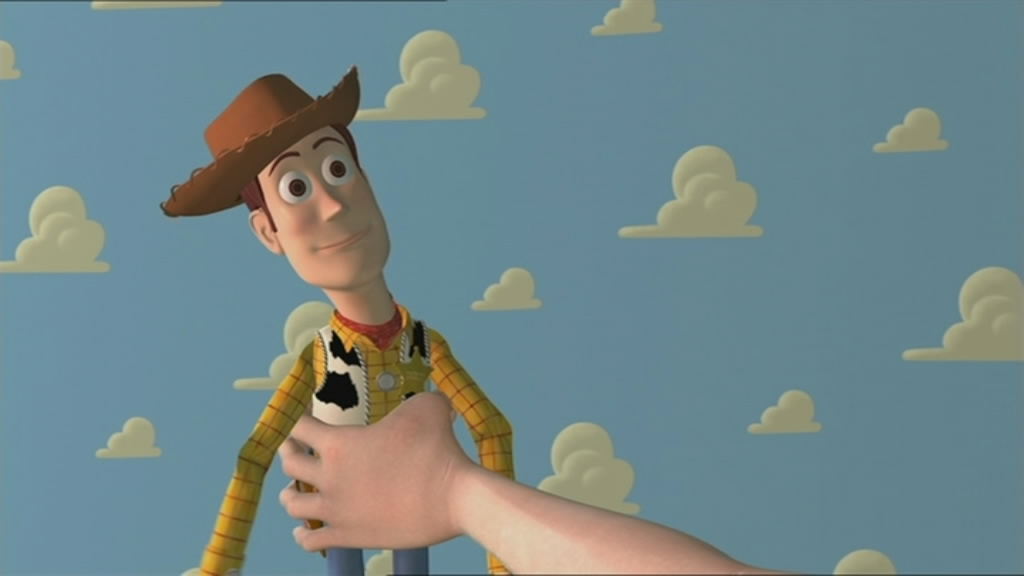
Woody.

Woody.

Using the toy soldiers in a giant bucket to spy on Andy and the party downstairs, they check off the various presents with increasing joy that among them is not some violent, degenerate toy who will threaten their way of life. Until, in a frenzy of action, Andy unwraps his last, and largest, toy. Blindsided by the rest of the children in the room, the solder captain cannot relay the message to Woody via the walkie-talkie, and the present, whatever it is, is quickly absconded with back to Andy’s room, where the toys must now hurry to return to their original positions. The kids all run in, whooping and hollering, chattering about how cool the new present is, just out of the eyeline of Woody himself.
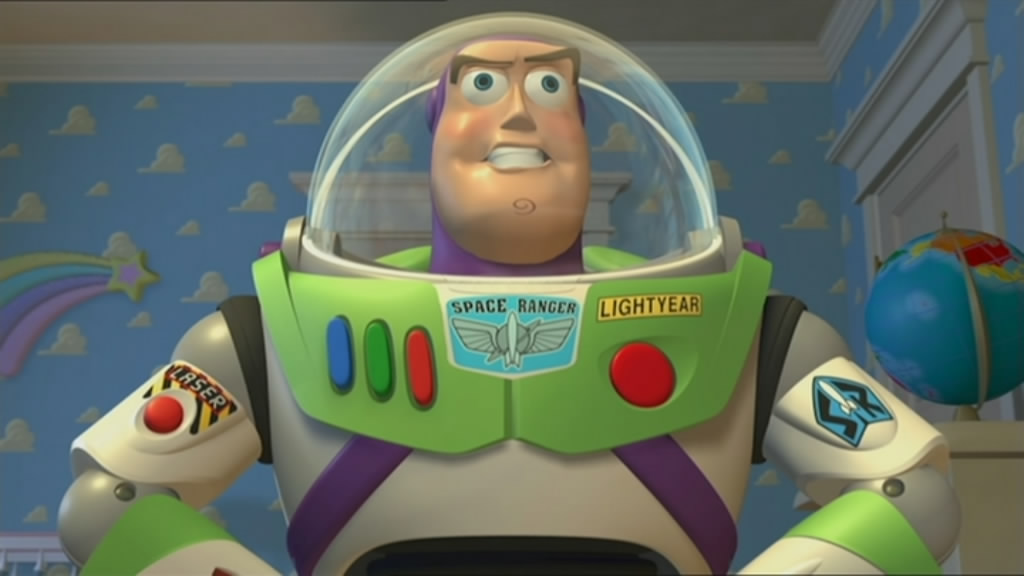
Buzz arrives in town.

Buzz arrives in town.

Then, the children are called for food, and the new present is plonked firmly on top of Andy’s bed, a position we find out is normally reserved for Woody. Woody, brushed aside in the fervour, clambers back onto the bed, and looks up, at the new toy which has usurped his position in Andy’s favour. It is Buzz Lightyear. A space toy, a light-flashing, helmet wearing, “flying” toy who has no idea he’s actually a toy. Buzz, viewing the rooms occupants with the disdain and arrogance of a spaceman landing on a planet unfamiliar, manages to insult Woody quite quickly, and begins regaling the rest of the toys (who, by the way, are in awe of the new addition to Andy’s collection) with his exploits.
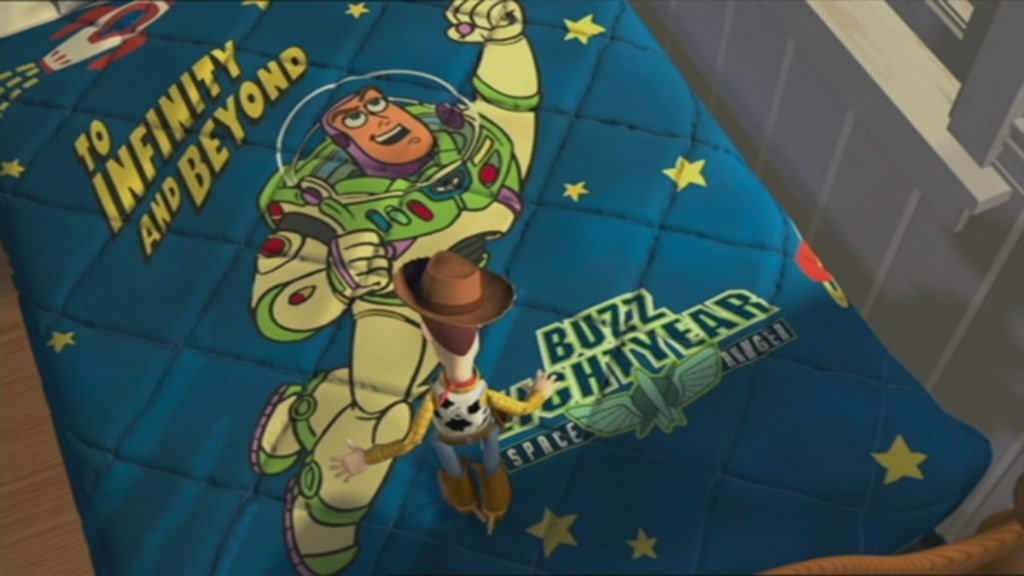
Buzz becomes the new favourite toy.

Buzz becomes the new favourite toy.

So begins Toy Story. The film uses themes of acceptance, jealousy, the sense of loss of place and a desire to be loved, to the most accessible, and unpretentious, manner possible in a film. Disney’s ethical stance on family, friendship and love are all in place, and Pixar’s storytellers have crafted a beautiful, wondrous story of two kindred spirits who don’t quite know it yet. Woody, voiced by Tom Hanks, is the jealous one, his position as Head Toy gradually being usurped by Buzz. It annoys him, so, of course, he set’s about trying to get rid of the newcomer, who he perceives as a threat. Of course, this is indicative of what we humans do when we come across something that threatens us: we try and get rid of it. Buzz is arrogant, self-assured and, unlike Woody, confident. Woody’s inability to see himself as a man of action is offset by his actions throughout the film, a quite contradictory manner he portrays as he comes up with a diabolical plan to rid his life of Buzz. Originally, director John Lasseter and the team at Pixar had Woody as a bit of a jerk, his action more overt in getting rid of Buzz, rather than the more understandable jealousy with which they imbued him. Woody is a sympathetic character here, since we can all recognise within him the sense of loss at his life being turned upside down. Buzz, in a great performance by Tim Allen, begins to come to terms with the fact that he is, in fact, a toy, and not a space-faring adventurer with lasers on his arms and mechanical wings on his back.
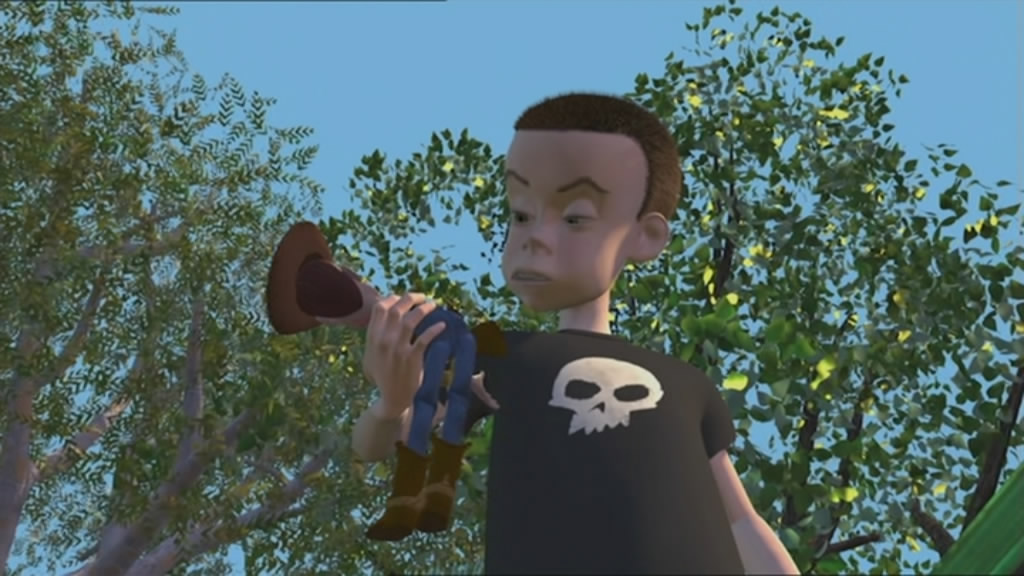
Sid, the evil kid next door. Karma is a bitch.

Sid, the evil kid next door. Karma is a bitch.

It’s this story point that I think Pixar excels at: showing us just how amazing they can be when allowing a character to follow his own path. Buzz doesn’t simply get told that he’s a toy and falls to the floor in a weeping mess, no, he is utterly convinced that he is what his packaging tells kids. Flying in the face of reason, Buzz embarks on a “mission” to repair his damaged craft (the box he arrived in, which is shaped like a plane) and sets in motion a series of adventures that take the toys away from the house and into the world. Danger lurks around every corner. The boy next door, a vicious thug named Sid, who enjoys destroying any toy he can find with the most abhorrent methods possible, is a constant threat. There’s the very real possibility that the toys will be discovered to be “alive” and made a spectacle of.
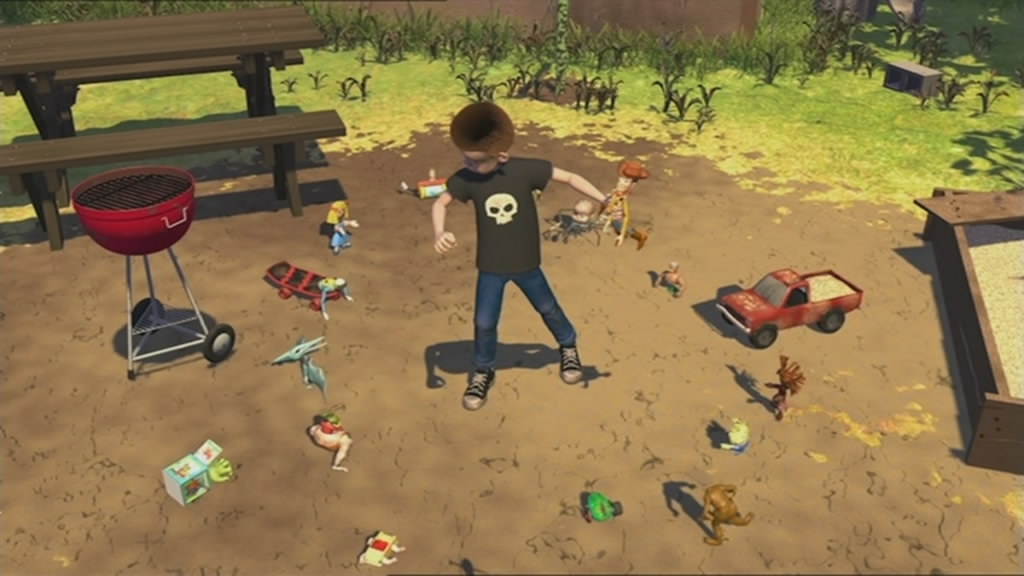
Revenge on Sid.

Revenge on Sid.

As Woody begins to appreciate Buzz’s friendship, and Buzz learns quite harshly that he is, in fact, a toy, the two come to an understanding of one another, and their own positions in the world. Woody learns that he doesn’t have to be the leader of the group, and that the toys are perfectly capable of looking after themselves. His position with Andy as his favourite toy is transitory anyway, which is a lesson he learns harshly, yet seems to accept quite readily by the end of the film. Buzz, his attitude towards Woody at first belligerent, and then more mellow, learns that he is one of millions of mass produced versions of the same toy, and while initially flipping out, and drinking tea with Mrs Nesbitt at Andy’s sister’s dolls tea party, he comes round.
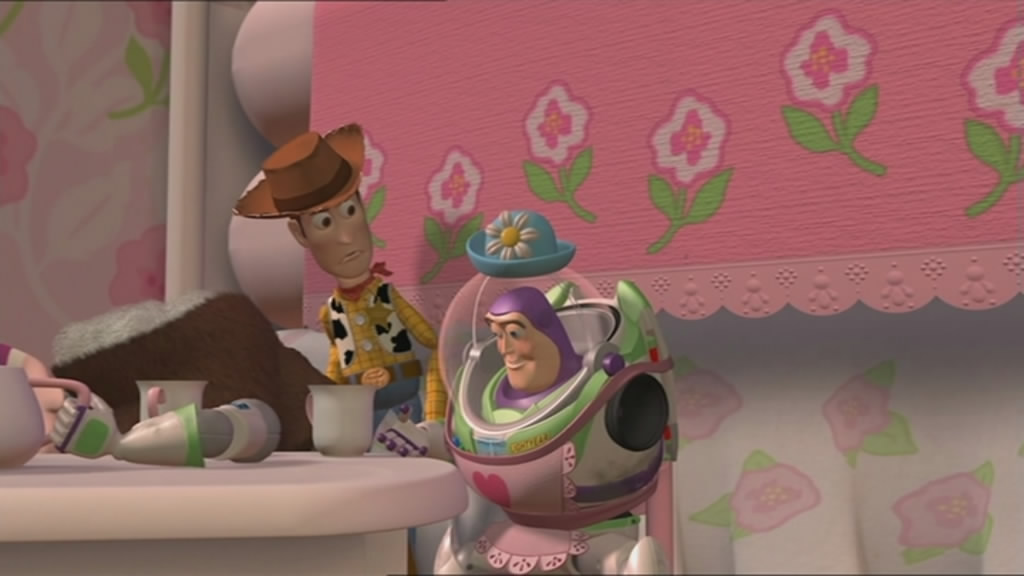
Buzz flips out, and takes high tea with Mrs Nesbitt. Woody can't understand it.

Buzz flips out, and takes high tea with Mrs Nesbitt. Woody can't understand it.

So where does Toy Story gain it’s appeal? Is it the animation? The storytelling? The characters? Honestly, I believe the film uses all it’s various facets to create a magnificent whole: all aspects of the film combine in a perfect symmetry of story that would, if you removed but a single part, collapse into mediocrity. Pixar’s attention to their characters is legendary. After all, if you don’t have good, solid characters, your film will simply fail. People need characters they can empathise with, identify with, to enjoy a film with. There’s no point in having characters who behave out-of-character for the sake of a story direction. Woody, Buzz, Hamm, Potato Head, even Sid, all behave in such a believable way, and true to their motivating characterisations, that they seem all the more real than had they been merely clichéd, generic versions. They are given personality by the animators, but also by the actors providing the voices. Hanks and Allen are superb in their roles as Woody and Buzz respectively. John Ratzenberger, perhaps best known as Cliff from the television series Cheers, is a scream as Hamm, and Wallace Shawn (whose distinctive voice landed him various stage and screen parts over the years) is wonderful as the timid toy tyrannosaurus Rex.
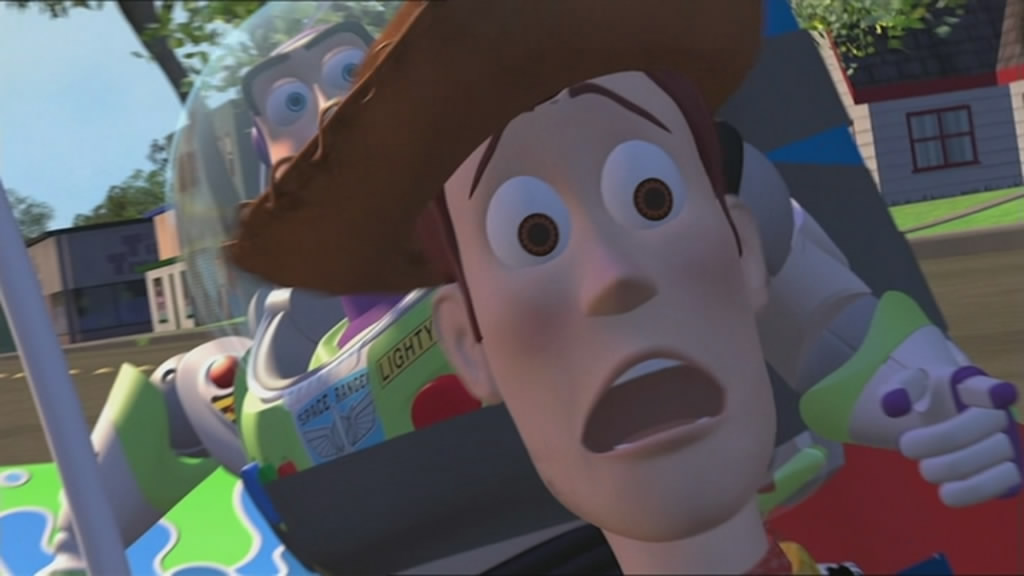
Buzz and Woody team up to save each other.

Buzz and Woody team up to save each other.

But it is not just the voices that drive the characters, although it is a fair portion. The animation on Toy Story still stands up to modern scrutiny, more than a decade on from it’s original release. With an eye-pleasing colour palette and some amazing, advanced, special effects and animation, the world of the toys is perfectly realised by (and perfects suited to) the animated style from Pixar. Buzz, his helmet transparent and wing-tips lit up with light, is a perfect symbol of the dazzling potential of computer animation. He’s a real toy, on screen at least, and looks so amazingly detailed it’s breathtaking. Woody’s clothing seems so real, you almost feel you could reach out and touch it. Advances in technology since the 90′s, when Toy Story was released, mean that today, the original film feels a little anaemic by comparison, but at the time, was revolutionary for it’s mastery of realism.
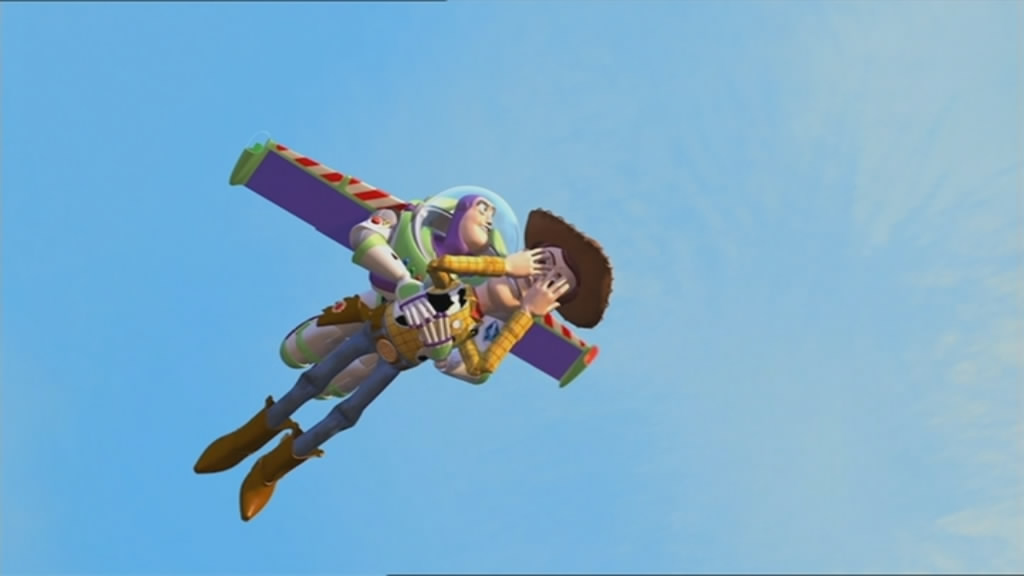
To infinity, and beyond.

To infinity, and beyond.

Yet, it’s not even this realism and superior technological skill that make Toy Story a true classic of modern film. What I think does it is the simple fact that the combination of great writing, some well rounded and developed characters, as well as the cinematic skill involved in bringing such a world to life, remains some way behind the fact that it’s the very essence of the story that makes this so accessible. Themes are overarching in their simplicity, they touch a part of each and every one of us, and that, in a way, brings us much closer to the story than you first think. Plus, it’s utterly entertaining, which merely serves to broaden it’s appeal as a film.

Rating: full-marks1

toy-story-review-pt-2

Once Toy Story, which was rightly hailed as a modern classic, was released to the public, Pixar still had four more films to go with their 5-picture deal with Disney in order to fulfil their obligations. With A Bug’s Life already in production, and on the way, the sequel to Toy Story was planned as a direct-to-video affair. When Disney saw how good the images for Toy Story 2 were looking, they decided to fund the film as a full length theatrical feature. This led to some conflict between Pixar boss Steve Jobs and then-Disney head Michael Eisner, the former feeling that the new film should be a part of the 5 picture deal, and the latter thinking it was not, since it was originally intended as a DTV piece.

Buzz kicks off the sequel in style. With a nice, shiny new jetpack.

Buzz kicks off the sequel in style. With a nice, shiny new jetpack.

Regardless of the politics involved, Toy Story 2 kicked off some time after the original film, story-wise, with Andy a little older, and a little wiser. Woody and Buzz, having now acclimatised to each other, have trained the family’s new puppy to obey their orders, something Andy has been unable to do himself. Things are going great, until Andy and his family hold a garage sale, and one of the toys is put up for purchase. Wheezy, the toy penguin with a broken squeaker, is about to be sold, however, Woody and Buzz have a plan to rescue him. Using the puppy as a “horse”, Woody makes his way to the front yard, and manages to save Wheezy. However, just as he is nearly safe, he falls from the puppy, and is picked up Andy’s mother. A toy collector, voiced by Wayne Knight, spots Woody and offers Andy’s mum a small sum of money for the toy, even though the woman admits he’s not for sale.

Al, the toy kidnapper, realises something is wrong.

Al, the toy kidnapper, realises something is wrong.

The collector, Al, uses an underhanded method of subterfuge to effectively steal Woody, and kidnaps him. The other toys are beside themselves with anger and worry, and begin to concoct a plan to rescue their fallen rescuer.

Toy Story 2 is a technically superior film to it’s predecessor in almost every way, and creatively, it’s an order of magnitude better. All the original cast return to voice their original roles from film 1, and with the addition of Wayne Knight, Joan Cusack and Kelsey Grammar (the latter two playing Jessie the Cowgirl, a counterpart of Woody’s, and Stinky Pete the Prospector, another of Woody’s line of toys, respectively) the film is broader, more epic, then before. Yet, unlike most film sequels, which are diminished and (usually) poorer quality, Toy Story 2 retains the same strengths and abilities of its predecessor, the story is strong, the characters well developed, and the animation is, again, technically brilliant.

Woody feels himself slipping away....

Woody feels himself slipping away....

Meeting Woody and Buzz again is like slipping into a pair of old shoes: instantly comfortable and easy to put on. You feel relaxed, like you know them so well. It must have been a stretch for the writers to not become bogged down in the characters’ own personalities, their own arcs from Toy Story, that they couldn’t allow them to grow. Woody and Buzz, you think, have gone as far as they can as characters in the original film. The screenplay, which involves themes of abandonment and loss, as well as those of finding family and treasuring what you have, is again resplendent with the kind of magic the original film delivered in spades. Plus, the scope of the film, with the plethora of additional characters (including Buzz’s chief toy-based villain, Emperor Zurg) is a lot more layered, allowing the writers and filmmakers to develop ideas and characters in a way that was beyond them in the original.

Jessie was quite happy to meet Woody....

Jessie was quite happy to meet Woody....

By far the biggest character arc in the film is reserved for Woody, whose discovery of his original toy line and genesis is both profound and heartbreaking, as he realises that he is among one of the world most collectable items in the toy industry. Al, the overweight, disgusting slob of a man with no moral centre whatsoever, is planning on sending Woody and his brethren, Jessie and Stinky Pete, as well as the toy horse Bullseye, to Japan as a complete set of Woody’s Roundup toys. Woody’s Roundup, a fictional Saturday morning animated show from televisions early years, shows Woody as the central character in the series, bringing children joy across the country, although, as Stinky Pete relates, the show was cancelled unexpectedly, leaving Woody and his friends to fade into the obscurity he now enjoys. Woody sees this show, and the plethora of marketing paraphernalia that Al has collected (from lunch boxes to records, to clothing and other items of manufactured joy) as a vindication of his worth as a toy, something he has searched for his entire life. But coupled with this new-found purpose is his loyalty to his friends, and to Andy, how owner. Jessie, voiced by Joan Cusack, replays her own heartbreak from her abandonment by her owner, leaving her without a home, in a poignant moment in the film. Jessie sees children as toy-abandoners, people who cannot be trusted to remember their once favoured toys, and the fact that Andy still loves Woody as his favourite toy merely rubs salt into the wound of her past. The duo of Woody and Jessie, and to some extent Stink Pete, are the catalyst for the emotional center of Toy Story 2.

Buzz and Zurg battle for galactic supremacy.

Buzz and Zurg battle for galactic supremacy.

Buzz, meanwhile, has to become the heroic figure he often touts himself as, as he leads the gang of Andy’s toys to rescue Woody from Al’s clutches. While his adventure in this film is perhaps more comedic than dramatic, his ability to cohese his fellow toys (again, Hamm, Potato Head and Rex all add their own personalities to this venture, and not always in the most constructive ways… their hearts, however, are often in the right spot) is the main thrust of his narrative. Tim Allen brings his voices swollen sense of pride and arrogance (a trait he honed on Home Improvement) into a character that’s as forever linked with Allen, as Allen is linked with Buzz. However, Buzz isn’t the same swell-headed character we saw in the original film by a long shot. He’s more understanding, more adventurous, and while still being fairly hot-headed in his decisiveness, is able to think and plan a course of action that will save both his friend (Woody) and those around him. I think Buzz in this film has a lot more depth as a character, even though perhaps he’s not the central storyline this time around. And with the characters limitations overcome from film 1, the writers must have been struggling with what to do with him. Personally, I think they did a great job, and a tip of the hat to them for one of animations great opening sequences, with Buzz attempting to break into the lair of Emperor Zurg and steal his power (!) in a sequence that’s chock full of references to films like Star Wars. Gary Rydstrom, one of the sound men who worked on Star Wars, is a man whom I regard as one of the great talents of the industry, and I think his work on this film is sublime.

Jessie & Woody share a tender, heartbreaking moment.

Jessie & Woody share a tender, heartbreaking moment.

As a side note, for those pondering just what I consider to be the greatest opening to an animated film, I should tell you that that honour goes to the introduction of Scrat in Ice Age.

It’s hard to imagine that a sequel to Toy Story could, in any way, be better than the original. Yet, John Lasseter and his team have crafted, nay, moulded, an example of defining storytelling and animation. The level of detail in Toy Story 2 is so far beyond the original it beggars belief, and with a story potentially more complex to deal with, handling all the relevant points of the narrative could have been quite tricky. The emotional beats of TS2 are plentiful, and scattered liberally throughout the story. Of course, it’s a Disney film too, so the ending is practically a foregone conclusion… although not so much that you find yourself thinking about it while watching. Such is the power of this film you find yourself seeing it as “real”, that is, not an animated film at all, but rather as live-action film of real toys doing real things. Well, I did, anyway. You may not, but then, if you can’t appreciate the art of this film, then you shouldn’t appreciate art, period.

Woody faces his worst nightmare. Seconds later, it would be different.

Woody faces his worst nightmare. Seconds later, it would be different.

In the pantheon of animated films, particularly those of a computer variety, Toy Story 2 ranks about as high as you can get, and for a while stood as the single most successful animated film of all time, only behind The Lion King. Of course, a few years later it was succeeded in this by runaway hit Shrek (which was superseded again by Shrek 2!) but as far as great storytelling, wonderful animation, and a dedication of it’s craftsmanship by those on the computers and at the storyboard, Toy Story 2 remains one of the defining animated films of this generation.

It’s a fair call to say that every CG animated film released today owes a debt of gratitude to Toy Story, and to Pixar generally. Without their immense talent, and the driving force of one John Lasseter, we would not now be blessed with such magnificent films as WALL-E, The Incredibles, Shrek, and Finding Nemo. Yet for all the advances in computer animation, with more technology to develop realistic hair and clothing, fur, and effects of light, Toy Story told one of the best stories for a film ever, as simply as it can be done. Minimal fuss, a solid foundation of character and class, witty dialogue and poignant performances by a great cast, Toy Story and it’s sequel remain, for me, the undisputed kings of all the CG films made since.

Buzz & Jessie make nice.

Buzz & Jessie make nice.

While some may decry the CG film as having less heart and soul than a traditional, hand-drawn work, I would disagree. While I cannot deny that CG films have been the catalyst for the demise of 2D art, which in itself is a terrible shame, these films have their own sense of life and destiny, the same care and consideration for story and heart beats within them as it did in the films Walt Disney himself created, back in the day. CG animated films, while looking cleaner, crisper and more suited to today’s audience, have a slew of different areas where they excel, over 2D animation. Some would say that since you’re using a computer to animate the film, you’re making a machine do it, rather than your own hands, with can be more “artistic” from a traditional sense. I respond to that by asking what the difference between a story hand-written or typed on a computer is? The soul of a film isn’t the way it was made, but rather, the idea of the thing itself. A handwritten book can have the same appeal as one typed into a computer, in much the same way that a 2D animated film can have the same emotional impact as a 3D version. It’s all about the story, and the emotional connection the viewer (or reader) has with it, not the format in which it’s presented.

snapshot20090208190349

You've got a friend in me.....

Art is art, and as far as Toy Story goes, it’s some of the best kind.

Rating: full-marks1


No Comments »

No comments yet.

RSS feed for comments on this post. TrackBack URI

Leave a comment

WPMU Theme pack by WPMU-DEV.

© 2007-2012 Fernby Films All Rights Reserved -- Copyright notice by Blog Copyright